
“I hope we can bring the joy back to medicine.” That line, from Dr. Lucienne Ide, founder and CEO of Rimidi, an ACT | The App Association member company focused on chronic disease management and remote patient monitoring, captured the theme that ran through CES.

Dr. Lucienne Ide speaking at the panel “Always On: How Continuous Health Data Is Transforming Care” on January 7, 2026
CES 2026 offered a clear view of where artificial intelligence (AI) is delivering value today. Across panels on healthcare, cybersecurity, and data infrastructure, speakers focused on how AI is being integrated into real systems to improve decision-making, reduce friction, and deliver measurable outcomes. What emerged was a consistent picture of AI as an enabling technology. It helps people work through complexity, prioritize information, and act with greater confidence. This is a point that we have emphasized in the past.
A recurring theme was the real value AI delivers by transforming information into actionable insight and supporting better decisions across systems. This perspective was reinforced by Amy Gleason, acting administrator of the United States DOGE Service, who pointed to both the progress already underway and the opportunity ahead. Across sectors, AI is already helping organizations make sense of complex information, identify patterns that would otherwise be missed, and act with greater speed and confidence. At the same time, Gleason emphasized that much of AI’s potential remains untapped, particularly as systems become more connected and information flows more freely. Much of AI’s value today is cumulative rather than dramatic. It improves how systems operate, helps organizations manage complexity, and strengthens efficiency and resilience across everyday use cases. This is where policy discussions would benefit from greater focus.
The Policy Question That Follows
These observations bring the policy discussion into focus. Morgan Reed, president of ACT, underscored the importance of grounding AI policymaking in real-world deployment and economic impact.
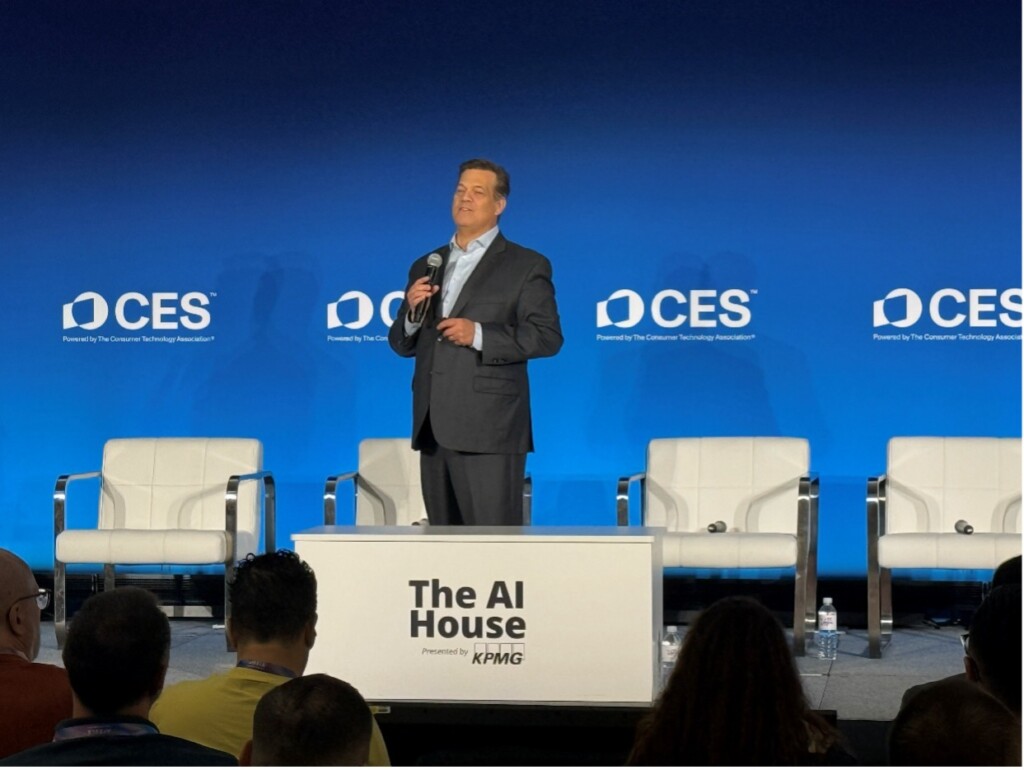
Morgan Reed speaking at the panel “Balancing the Risk and Rewards of AI” at the CES AI House on January 6, 2026
AI is already delivering tangible benefits, particularly for small businesses that rely on these tools to compete, scale, and reach new markets. For developers, users, and beneficiaries of AI, managing risk is an evolving task. For policymakers, a key objective is to support and strengthen these risk management methods while ensuring that law and policy help maximize AI’s economic and social benefits.
In new research coming soon, ACT is mapping existing U.S. laws to AI applications, showing how many of the concerns now associated with AI are already addressed through well-established legal frameworks. Existing laws in areas including employment, housing, consumer protection, privacy, and competition law, alongside industry-led standards, can guide responsible AI deployment. At the same time, the rapid proliferation of AI-related legislation has introduced overlapping and inconsistent requirements that impose compliance burdens, especially on smaller innovators, without clear evidence of improved outcomes.
CES offered a grounded counterpoint. It showed AI being deployed responsibly and incrementally by companies focused on solving specific problems. These deployments are shaped by standards, coordination, and practical incentives. Policy choices that align with these realities are more likely to support innovation and adoption. AI creates the most value when policy emphasizes coordination over fragmentation and adoption over fear.
That is how we bring the joy back to AI innovation.