
The space industry is entering a new era. Satellite broadband, low-Earth orbit constellations, remote sensing, direct-to-device connectivity, and emerging in-space services are moving from specialized applications into core digital infrastructure. These technologies can expand broadband access, strengthen emergency communications, support new business models, and improve resilience across the economy.
That growth also raises hard regulatory questions. Policymakers must address spectrum access, licensing timelines, orbital debris, interference, space traffic coordination, remote sensing, and international market access. The challenge is to manage those issues without creating a regulatory environment that slows deployment or makes it harder for new entrants to compete.
On April 22, the Association for Competitive Technology (ACT), the American Bar Association’s Section of Science & Technology Law, and Arizona State University’s (ASU) Sandra Day O’Connor College of Law convened a panel, Navigating the New Space Regulatory Frontier, to examine these issues. The discussion featured keynote remarks from Jay Schwarz, chief of the Federal Communications Commission’s (FCC) Space Bureau, followed by a panel moderated by Brian Scarpelli, senior global policy counsel at ACT. Panelists included Mary Guenther, head of space policy at the Progressive Policy Institute; Jim Dunstan, general counsel at TechFreedom and adjunct professor at ASU Law; Derek Hanson from the Office of General Counsel at the National Oceanic and Atmospheric Administration (NOAA); and Priscilla Argeris, lead for domestic regulatory satellite affairs at Amazon Leo.

From left: Brian Scarpelli, senior global policy counsel at ACT; James Dunstan, senior counsel at TechFreedom and ASU adjunct professor; Mary Guenther, head of space policy at the Progressive Policy Institute; Derek Hanson, attorney-advisory at the Department of Commerce for National Oceanic and Atmospheric Administration; and Priscilla Argeris, Amazon Leo Regulatory Affairs lead, discuss space regulatory systems at the Sandra Day O’Connor College of Law’s Navigating the New Space Regulatory Frontier event at the ASU Barrett & O’Connor Washington Center. Photo courtesy Hager Sharp
Modernizing U.S. Space Regulation
Schwarz opened the discussion by describing the commercial space sector as entering a space Industrial Revolution. The number of satellites and space-based services is growing rapidly, while business models are changing just as quickly. In his view, the regulatory system must scale with that reality.
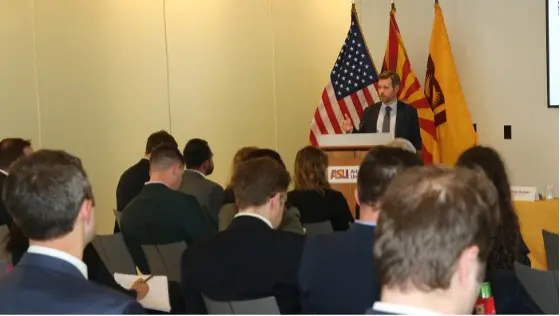
Keynote speaker Jay Schwarz, chief of the Federal Communications Commission Space Bureau, speaks on the future of space infrastructure at the Sandra Day O’Connor College of Law’s Navigating the New Space Regulatory Frontier event at the ASU Barrett & O’Connor Washington Center. Photo courtesy Hager Sharp
The FCC’s reform agenda reflects this shift. Schwarz highlighted efforts to expand spectrum access, streamline satellite licensing, create more predictable review timelines, and simplify license modifications. These reforms affect whether operators can launch services, raise capital, update systems, and respond to market needs.
That point carried through to the panel discussion. The United States already has several agencies involved in commercial space. The FCC handles communications and spectrum licensing. NOAA plays a central role in remote sensing. The Federal Aviation Administration (FAA) regulates launch. The Commerce Department is increasingly focused on commercial space operations and space situational awareness. Derek Hanson brought an important agency perspective to this conversation, particularly around the Commerce Department’s role and the need to build authorization frameworks that can support new activities without creating unnecessary uncertainty.
The panel made clear that interagency coordination will matter more as commercial space evolves. New services do not always fit neatly into old categories. In-space servicing, refueling, orbital transfer vehicles, lunar systems, direct-to-device connectivity, and space-based infrastructure will require regulators to think beyond traditional communications and sensing models. Agencies need to coordinate around deployment and safety at the same time.
The Transatlantic Challenge
A major theme of the event was the growing divergence between the United States and Europe.
The EU Space Act is framed as an effort to harmonize space rules across Europe. While a single European framework could reduce fragmentation across EU Member States and create clearer rules for authorization, registration, supervision, safety, and sustainability, the proposal also raises concerns for U.S. operators. In the keynote Q&A, Schwarz was asked whether the EU Space Act could create a dynamic similar to the EU’s Digital Markets Act (DMA): a regional regulatory framework with consequences that extend beyond Europe. The concern is that U.S. operators seeking access to European markets, customers, or infrastructure could face an additional compliance layer on top of U.S. licensing, spectrum, launch, remote sensing, and safety obligations.
The comparison is useful. Regional regulation can become global in practice when companies must redesign compliance systems around the most demanding jurisdiction. In digital markets, the DMA has shaped platform operations, product design, and compliance decisions for companies serving global markets. In space, a similar concern could emerge if access to European markets or launch infrastructure requires U.S. operators to satisfy a separate European compliance regime layered on top of domestic obligations.
This does not mean Europe should avoid regulating space activity. Orbital debris, resilience, authorization, and sustainability are legitimate policy concerns. The issue is how those rules are designed and applied. A harmonized framework can reduce complexity inside Europe, but it can also create new burdens for foreign operators if it is overly broad or duplicative.
Innovation, Competition, and Market Access
Mary Guenther brought a broader policy perspective to the discussion, connecting space regulation to innovation, competitiveness, and U.S. leadership. Commercial space is increasingly tied to economic growth, broadband access, national resilience, and technological competition. Regulatory systems should reflect that importance.
Jim Dunstan added legal and institutional perspective, particularly around the risks of outdated frameworks being applied to fast-changing space activities. Space law is no longer limited to a small set of government or legacy commercial actors. The market now includes new entrants, smaller firms, service providers, and downstream businesses that depend on space-enabled infrastructure.
Priscilla Argeris brought the operator perspective. For companies building and deploying satellite systems, regulation is not an abstract policy debate. It shapes engineering choices, launch timelines, service availability, and investment decisions. When companies operate across jurisdictions, compliance obligations can quickly become complex. That complexity is especially difficult for smaller firms and suppliers that do not have the same legal and regulatory resources as larger operators.
This is where the small business implications become clear. Large companies may be able to manage overlapping domestic and foreign compliance obligations. Smaller companies often cannot. They may rely on satellite connectivity, remote sensing, cloud infrastructure, or space-enabled communications as inputs for their own products and services. If regulatory fragmentation raises costs or slows deployment, the effects can reach far beyond satellite operators themselves.
A Practical Path Forward
The panel underscored a basic point that commercial space needs rules that match a dynamic market.
That means timely and predictable licensing, risk-based regulation, better interagency coordination, and international frameworks that avoid unnecessary extraterritorial burdens. A broadband constellation, a remote sensing platform, and an in-space servicing vehicle do not raise the same questions, and regulation should reflect those differences.
The United States and Europe share important goals, including safety, sustainability, resilience, and innovation. Those goals are best served through coordinated, flexible rules that address real risks while allowing the next phase of commercial space innovation to grow.