
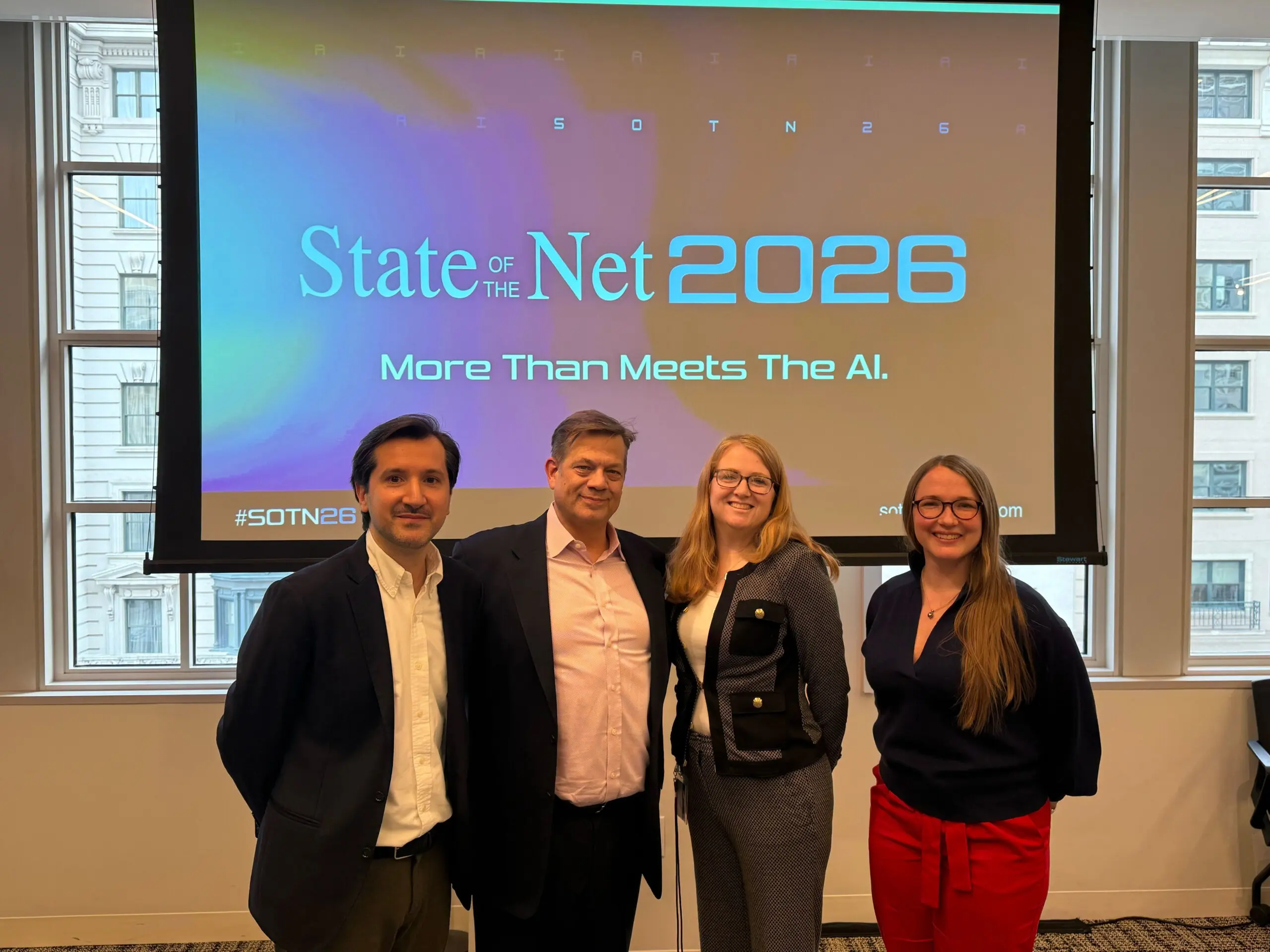
At this year’s State of the Net Conference, our president, Morgan Reed, participated in a panel titled “Sovereign AI and the New Internet Order: Governing Intelligence Across Borders.” Speaking to a standing-room-only crowd, Morgan and his fellow panelists addressed the opportunities and challenges inherent in artificial intelligence (AI) governance. Throughout the discussion on data center ownership, risk management approaches to AI, and national cybersecurity policies, technical standards and standard-essential patents (SEPs) emerged as a key battleground for the new AI frontier.
Moderator Nancy Scola asked panelists to define “sovereign AI,” a tricky concept that gets applied in many ways. Panelists focused on two key ideas: a country’s ability to control their own technology, data, compute power, and talent, and a country’s ability to control or set the actual standards and measurements for AI use within its borders. As the panel talked through the importance of clear definitions and trust both in the AI systems and in the governments regulating them, the importance of standards for helping smooth the global flow of information became obvious. Standards allow for a shared lexicon, panelist Caitlin Clarke of Venable LLP pointed out, and they help you to develop trust in the technology stack. Kellee Wicker of Meridian International Center agreed and highlighted that even the where matters: the location of a standards-setting meeting dictates which countries and companies will have the most influence, and how a technology standard will develop.
Morgan pointed out that not only does the location of a standards meeting matter, but the attendees matter as well. If the United States sends 50 or 60 engineers to a meeting, China might send 500. Their government has prioritized standards organizations, recognizing their power to shape the development of technology, and underwrites the attendance of Chinese engineers to help prop up their worldview in the standards body. The United States can counteract this influence by involving more of our own companies in the standards process, ensuring that small businesses can have a voice in standards development.
The audience was highly engaged, offering thoughtful questions on the development of AI governance. One in particular resonated with the theme of concerns around AI governance in new frontiers: what happens when data centers are launched into space, and the countries or companies that send up those satellites are not signatories to key treaties on privacy and other concerns? Morgan answered that the standards covering data privacy already exist, and buyers have the power to require compliance with key privacy, liability, and other standards from their vendors.
The key role technical standards play in AI puts abusive SEP licensing practices center stage in the sovereign AI discussion. When SEP holders offer their patented technologies to be declared as essential to those standards, they generally agree to license them on terms that are fair, reasonable, and non-discriminatory (FRAND). The FRAND commitment is the bulwark against anticompetitive SEP licensing conduct that safeguards the innovation that should happen on top of standardized technologies. Unfortunately, a small minority of abusive SEP holders inappropriately prevent innovators from interoperating with technical standards by refusing to license FRAND-encumbered SEPs or seeking injunctions, among other tactics designed to extract maximum fees that exceed FRAND rates. Policymakers around the world must recognize these instances where SEP holders go back on their FRAND commitments as a serious impediment to AI goals. Because the development and adoption of AI technologies is interwoven with the development of the technical standards that undergird their growth, whether SEP holders are held to their FRAND commitments could make or break sensible sovereign AI policies.
It became clear through the discussion that standards and SEPs will continue to retain their importance in the debate over governance of new AI technologies. We thank State of the Net for hosting such an insightful panel, and for the discussion on all types of AI governance topics.