ACT | The App Association had the privilege of sponsoring one of Korea’s largest startup conferences, COMEUP, the global startup festival in Seoul, hosted by the Korean Ministry of Small and Medium Enterprises and Startups (MSS) and jointly organized by the Korea Startup Promotion Agency, Korea Startup Forum, Korea Venture Business Association, and Korea Venture Capital Association. The festival served as a global exchange venue centered on technological innovation and entrepreneurship under the slogan “Recode the Future.”
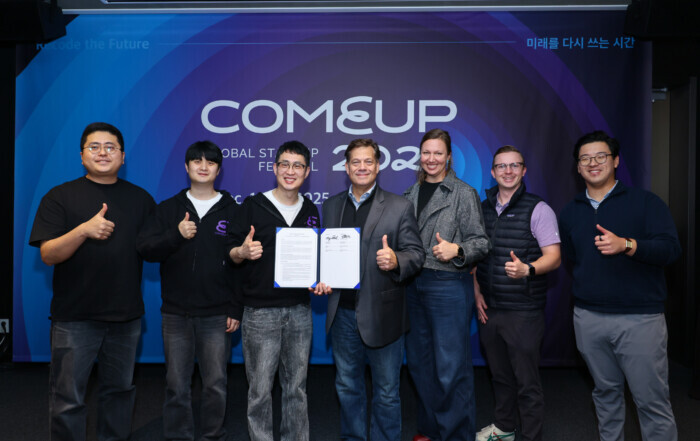
ACT staff spent the week connecting with Korean and APEC developers to better understand the opportunities and challenges within Korea’s vibrant technology ecosystem. During the visit, ACT met with startup leaders, SME community stakeholders, and policymakers to continue discussions on creating a digital ecosystem that supports SMEs globally. At the end of COMEUP, ACT had the pleasure of signing a memorandum of understanding with one of Korea’s largest startup communities, the Korean Startup Forum, expanding our partnership and strengthening the ties that bind together the global startup and small tech community.
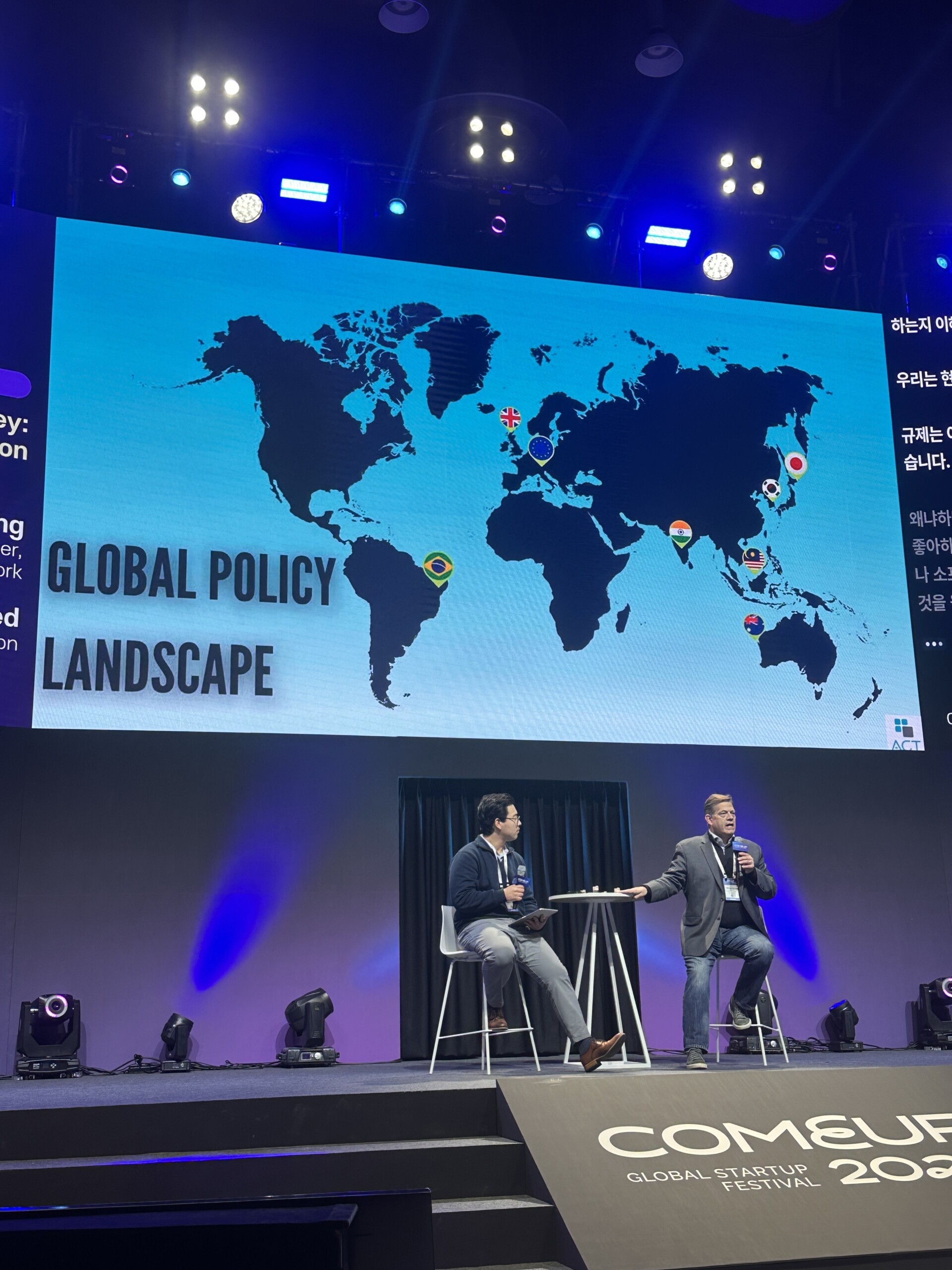
On December 11, ACT President Morgan Reed and I held a main stage fireside chat titled From Seoul to Silicon Valley: The Power of Policy in Globalization. We spoke about why SME and startup leaders need policy awareness and knowledge if looking to expand in a shifting global policy landscape.
With more than two decades of experience advising startups, engaging policymakers in Washington and capital cities around the world, and serving on international boards and advisory committees, Morgan has seen firsthand how regulation can either unlock opportunity for SMEs or quietly close doors. Across the Asia-Pacific Economic Cooperation (APEC) region, and in Korea specifically, competition authorities are taking a fresh look at the role of digital platforms and curated online marketplaces (COMs) in fostering healthy, innovative ecosystems. These platforms, and the emerging technologies they enable, are indispensable to startups and scaleups seeking to innovate, grow, and compete globally.
Morgan explained that COMs, such as app stores and other managed digital platforms, are best understood as infrastructure. Much like roads or railways, they enable scale by lowering barriers to entry. For startups, COMs reduce overhead costs, provide intellectual property protections, establish consumer trust, and offer immediate access to global distribution. Rather than negotiating dozens of market-specific compliance regimes or building costly distribution systems from scratch, SMEs can focus on innovation while leveraging the tools and services marketplaces provide. This model, Morgan noted, is a core reason small teams can now reach global audiences and compete with far larger incumbents.
The discussion then turned to the rapidly evolving global regulatory environment. Governments around the world are increasingly considering prescriptive, ex-ante platform regulations modeled on the EU’s Digital Markets Act (DMA) and similar proposals. While often framed as pro-competition, Morgan warned that these policies risk undermining the COMs infrastructure that enables startup growth. By restricting basic marketplace management functions or imposing blanket obligations, such regulations can reduce security, slow feature development, and raise compliance costs, burdens that disproportionately fall on SMEs. Morgan highlighted how venture capital decisions are tied to market size and growth potential:
“When policy fragments markets or limits scale, it reduces the incentive for global investment, making it harder for startups to attract funding, expand internationally, or deploy emerging technologies like artificial intelligence.”
The conversation concluded with Morgan emphasizing that SMEs retain a powerful advantage: adaptability. Founders who understand policy trends and engage early can better anticipate risks, identify growth opportunities, and position themselves ahead of competitors. In Korea, Morgan noted, there is a clear opportunity to lead by aligning innovation-friendly policy with global market access, ensuring startups can scale outward rather than be constrained by fragmented rules. The message was clear. Policy is no longer a background issue for startups. It is a core part of the competitive landscape and a central component of SME strategy. For founders looking to grow globally, understanding the rules of the road is just as important as building the next great product.
We continued the discussion the following day, when I had the privilege of hosting Young Suk Kim, CEO of ACT member company Dr. Friend, a rapidly growing sleep-care company building non-pharmaceutical, technology-enabled solutions to address one of the most pressing challenges of modern life: chronic sleep degradation. Our fireside chat, titled Born in Korea, Built for the World, focused on the experiences and challenges of expanding a startup globally.
When asked how Dr. Friend approached international market entry, Kim described an “experience-driven expansion” strategy. Rather than pursuing rapid, shallow entry into multiple markets, the company focused on building deep trust with users in individual regions. In Australia, for example, a single customer’s strong experience became the foundation for establishing a local subsidiary and the forthcoming opening of a Sydney center. Similar momentum has followed in the United States, Japan, Indonesia, Austria, and Vietnam. While still early in scale, growth has been steady and grounded in accumulated user trust. Kim emphasized that understanding local markets and building relationships are essential to long-term global success. He also underscored that trust is the cornerstone of healthcare adoption and that policy plays a critical role in establishing and sustaining that trust. He pointed to three areas where government support can make a meaningful difference:
“Expanding funding for clinical research and validation, assisting startups with global certifications and international exhibitions, and ensuring stable, predictable digital platform policies that allow companies to reach customers at scale.”

For startups operating at the intersection of hardware, software, and health, consistent digital policy frameworks are not abstract concerns. They directly shape the ability to innovate, grow, and compete globally. As our discussion made clear, Dr. Friend’s story reflects a broader lesson for founders everywhere. Global success is built on trust, evidence, adaptability, and policy environments that reward, rather than restrict, innovation.
In between the fireside chats and dozens of conversations with SMEs and startups at COMEUP, we also had the opportunity to engage with policymakers and members of the innovation community at a closed-door reception hosted by the Digital Industry Policy Association, one of Korea’s leading digital policy networks. At the reception, Morgan presented research examining how global platform regulations, particularly those modeled after the EU’s DMA, are reshaping innovation, investment, and competitiveness for SMEs.
Morgan began by grounding the discussion in Korea’s strengths. With near-universal internet penetration, a mobile-first consumer base, and SMEs accounting for nearly all Korean firms, the country is well-positioned to lead the next phase of the digital economy. The digital sector is projected to account for nearly one-third of GDP by 2028, with e-commerce and mobile app development continuing to grow rapidly. However, Morgan emphasized that scale alone is not enough. For Korean startups to compete globally, they must be able to reach international customers, deploy emerging technologies like artificial intelligence, and operate within predictable regulatory environments.
He described the DMA not as a theoretical policy experiment, but as a real-world case study with measurable consequences. One of the most immediate impacts, he noted, has been delayed access to frontier AI tools:
“The data shows that a majority of SMEs in the EU and UK are experiencing slower AI rollouts as companies reassess compliance risk. For small businesses, these delays translate directly into lost productivity, higher costs, and reduced competitiveness. Estimates show that AI delays and compliance burdens can cost individual SMEs hundreds of millions of won annually, while aggregate compliance costs in Korea under DMA-style rules could reach nearly one trillion won, roughly 0.04 percent of GDP. Importantly, the majority of these costs would fall on micro and small businesses rather than large firms.”
He stressed that these are not abstract projections. They represent foregone investment, slower hiring, and missed opportunities for startups seeking to scale internationally. For Korea and other emerging technology economies, the challenge is to design digital policies that preserve openness, accelerate AI adoption, and keep SMEs competitive in the global market through clear regulatory guidance and fewer barriers to growth.
As these conversations in Korea underscored, startups succeed globally when innovation, trust, and policy move in the same direction. From infrastructure like COMs that lower barriers to entry, to digital health companies like Dr. Friend that pair scientific rigor with scalable technology, Korean founders are demonstrating what is possible when SMEs are empowered to reach global audiences. ACT looks forward to continuing this work and deepening partnerships with Korean innovators, policymakers, and industry leaders to advance a digital ecosystem grounded in openness, predictability, and opportunity. By fostering cross-border cooperation and innovation-friendly policy, we can help ensure the global digital economy works for SMEs and scaleups in Korea and around the world.
Thank you to all the new faces and dedicated leaders who made this visit meaningful. We look forward to continuing these conversations and returning in the year ahead.