












Morgan Reed Testifies Before House Subcommittee on Courts, Intellectual Property, Artificial Intelligence, and the Internet
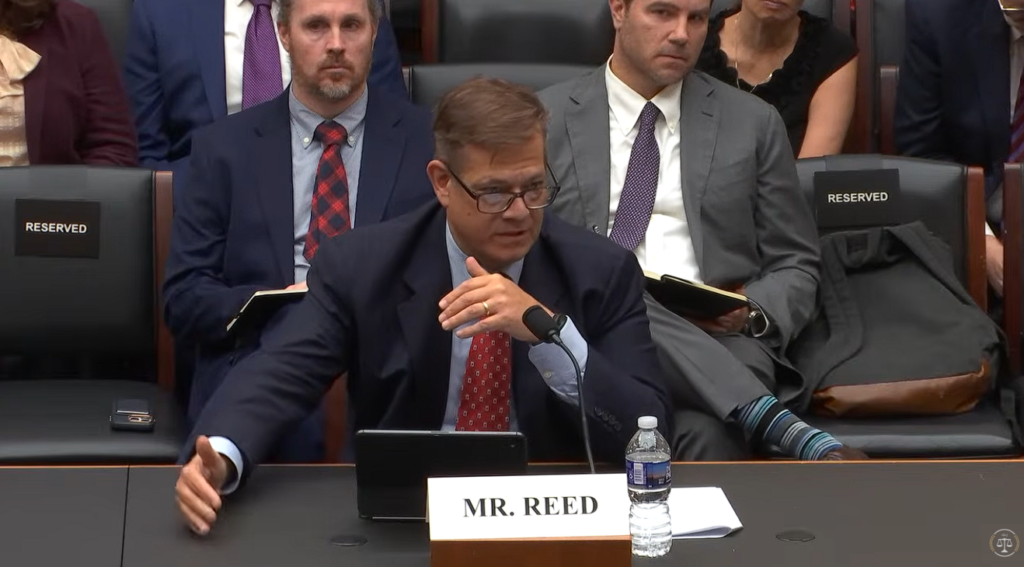

Morgan Reed
I. Introduction
We applaud the Subcommittee for holding this hearing on renewing the United States Patent and Trademark Office’s (the Office’s or USPTO’s) statutory fee-setting authority. The Patent Act authorizes and requires USPTO’s Director to collect a range of specific and general fees associated with patent applications, examinations, and issuance.[1] Enacted in 2011, the Leahy-Smith America Invents Act (AIA) further authorized the Director to “set or adjust by rule any fee established, authorized, or charged” under the organic statute.[2] This authority expires in mid-September 2026, setting up the present hearing.
We believe the Subcommittee’s framing is appropriate and particularly timely. The pending renewal of USPTO’s fee-setting authority provides an important opportunity to consider not only whether the Office should continue to set its own fees, but whether it is faithfully administering the broader statutory framework in which Congress granted that authority. Fee-setting authority was one component of the AIA. The same legislation also created new mechanisms for improving patent quality and efficiently reviewing patents that should not have been issued. We are concerned that recent USPTO actions have narrowed access to those mechanisms and pushed substantive patent policy beyond clear statutory authority, to the detriment of small innovators and startups. Congress should use its renewal authority to restore clearer limits, stronger oversight, and a renewed focus on patent quality.
The Association for Competitive Technology (ACT) is a not-for-profit trade association representing the small business technology developer community, including the small manufacturers who design, build, and ship connected products. Our members include startups, app developers, and device makers whose products range from medical and diagnostic equipment to industrial sensors, agricultural systems, and automotive components. They own and use patented technologies and rely on a fair, predictable intellectual property system. The value of the U.S. ecosystem ACT represents, the app economy, is approximately $1.8 trillion and is responsible for 6.1 million American jobs, and device manufacturers are among its core participants.[3] An appendix to this testimony identifies small business technology companies located in the districts of Members of this Subcommittee.
ACT is pro-patent and supports strong intellectual property rights. We believe patents promote innovation while providing a means for inventors to benefit from their contributions. But strong patent rights depend on strong patents. Protecting innovation therefore requires both rigorous examination before a patent issues and effective mechanisms for correcting errors afterward.
ACT strongly supported giving the Director fee-setting authority when Congress enacted the AIA. That support rested on the premise that the Office would administer the delegated authority in service of the statute Congress had just enacted, including its patent-quality objectives and the post-grant review system created in the same law. Recent Office conduct calls that premise into question.
The Patent Act outlines USPTO’s core powers and responsibilities, foremost among them examining patent applications and administering the patent system.[4] Major technology shifts can strain that system. In the mid-2000s, rapid growth of software patenting helped expose weaknesses that Congress addressed through the AIA. The proliferation of questionable and overly broad software patents also contributed to the rise of patent assertion entities (PAEs) that could acquire patents and monetize them through infringement demands and litigation rather than by developing products themselves. Congress responded in part by creating inter partes review (IPR), providing a faster and less expensive mechanism for challenging asserted patents.[5] Today, artificial intelligence (AI)-enabled products and services are creating comparable pressures through both AI-related inventions and AI-assisted patent drafting. As patenting accelerates in another rapidly developing technological field, weakening access to the very review mechanism Congress created to address these patent-quality and abusive-assertion problems risks repeating them. Those pressures make rigorous examination and effective error correction mechanisms more important, not less.
It is against this backdrop that the USPTO has moved in the opposite direction. Over the past year and a half, the Office has expanded the grounds on which the Director may deny IPR petitions on discretionary grounds, centralized all institution decisions in the Director, proposed additional restrictions on access to IPR, and advanced new barriers to other forms of post-grant review. The cumulative effect is to make it more difficult to obtain merits review of patents that may never have satisfied the statutory requirements for patentability.
At the same time, serious strains within the examining corps threaten the quality of the Office’s front-end review. A recent GAO investigation found that examiners described an institutional emphasis on production over quality, insufficient time to thoroughly examine applications, and incentives that reward output without comparable rewards for patent quality.[6] Those concerns are particularly significant as the Office prioritizes reducing its application backlog and increasingly looks to AI to improve examination efficiency. Reducing pendency is important, but it cannot come at the expense of rigorous examination. Weakening the conditions for careful front-end review while simultaneously restricting the mechanisms Congress created to correct errors after issuance puts patent quality at risk at both ends of the system.
The Office has also increasingly inserted itself into substantive enforcement disputes, disproportionately advantaging patent owners to the detriment of operating, manufacturing, and other U.S. product companies. Recent joint statements of interest with the Department of Justice Antitrust Division in private U.S. District Court litigation have inexplicably supported injunctive relief in cases involving standard-essential patents (SEPs) and patent trolls, despite injunctions being only rarely appropriate remedies for SEP infringement under federal case law.[7] These activities are also ill-timed, as a broadening set of industries rely on the predictability of SEP licenses in order to interoperate with technical standards, from 4G and Wi-Fi to video codecs.
ACT supports ensuring that the Office has the resources needed to perform its statutory functions. But fee-setting authority is not the same thing as an appropriation, and renewal should not be treated as a routine budget exercise. Congress is deciding whether to continue a broad delegation that lets the Office determine how particular user fees are structured, subject to the aggregate-cost limitation Congress imposed.
In the AIA, Congress created that delegation, prescribed procedural safeguards around it, and created the PTAB. Recent Office actions that depart from statutory text in order to narrow access to congressionally created review mechanisms therefore bear directly on whether, and on what terms, Congress should renew that delegation. This is an appropriate moment to examine whether the Office is faithfully implementing the AIA, whether the discretion it has exercised is consistent with the statutory framework, and whether additional guardrails are necessary before delegating fee-setting authority again. Congress should carefully consider whether to reauthorize the fee-setting authority and, if it should, whether it should enact additional clarity as to the Director’s discretion in matters like PTAB review.
II. The Scope and Limits of the Fee Authority Congress Delegated
The AIA’s fee-setting authority gives the Director substantial flexibility, but it is not unlimited. The Office may set individual patent fees above or below the cost of the particular service, provided that patent fees in the aggregate recover no more than the aggregate estimated cost of patent operations, including associated administrative costs. That structure is distinct from appropriations: the USPTO is funded through user-fee collections and requests congressional authority to spend those collections, while Section 10 separately determines how much discretion the Director has to design the fee schedule.
Because the aggregate-cost standard is so broad, Congress is not merely deciding whether the Office can keep the lights on, but whether to continue giving the agency wide latitude to shift costs among different patent activities and users. A delegation that broad should be paired with clear statutory direction about the purposes it is meant to serve and meaningful oversight of whether the Office is carrying out the rest of the AIA faithfully.
Congress deliberately sunset the AIA’s fee-setting authority so that the USPTO would have to return to Congress for reauthorization. That accountability mechanism is especially important after Arthrex[8] reinforced the Director’s control over PTAB adjudication, leaving Congress’ periodic decision whether—and on what terms—to redelegate its authority an important check on an increasingly centralized agency.
Patent Public Advisory Committee (PPAC)
Congress also built consultation into the fee-setting process. Before proposed patent fees move through rulemaking, section 10(d) of the AIA requires the Director to provide the Patent Public Advisory Committee (PPAC) with the proposal. PPAC then holds a public hearing and issues a written report, and the Office must consider that input before proceeding. PPAC is a nine-member statutory advisory body charged with reviewing patent policies, performance, budget, and user fees.
For much of the current Administration, however, that congressionally mandated safeguard has been effectively disabled. On March 18, 2025, the Secretary of Commerce removed all nine sitting PPAC members, the first time in the committee’s history that an Administration removed its entire membership. Section 5(a)(1) requires that any vacancy be filled within 90 days, but the first replacement members were not named until September 8, 2025—nearly six months later— and the committee has operated below its statutory complement ever since. The Office has only recently appointed a fourth member, leaving a majority of the nine statutory seats vacant more than 17 months after the entire committee was removed. The consequences have been substantive, not merely administrative: PPAC did not hold its ordinarily scheduled public meetings in May or November 2025 and did not issue its statutorily required FY2025 annual report.[9]
The timing is particularly troubling because the absence of a functioning PPAC coincided with some of the most consequential changes to patent policy since enactment of the AIA. The March 2025 discretionary-denial memorandum, the October 2025 IPR rulemaking, and the July 2026 ex parte reexamination proposal all proceeded while the body Congress specifically charged with reviewing the Office’s policies, performance, budget, and user fees was unable to perform that role as Congress designed it. PPAC’s function is not simply to advise the Office on fee amounts; Congress designed it to provide outside expertise, continuity, public scrutiny, and stakeholder input into the administration of the patent system. [10]The prolonged vacancies eliminated much of that statutory check precisely when the Office was exercising unusually consequential policy discretion.
That failure is especially relevant here because Congress is now being asked to renew another broad delegation of authority to the same agency. Congress should not extend fee-setting authority on the assumption that the safeguards accompanying that delegation will protect against misuse when the Office has allowed one of its principal statutory oversight mechanisms to remain largely nonfunctional. Fee-setting authority should require a fully constituted PPAC, timely public meetings and annual reports, and meaningful PPAC review before major fee or patent-policy changes take effect.
III. A Strong Patent System Depends on Patent Quality
Strong patents are indispensable to small business innovation. For an early-stage company, intellectual property may be among its most important assets. Patent rights can help a startup secure investment, drive enterprise value, establish a licensing program, protect a technological lead, and negotiate with substantially larger competitors. That is as true for a small manufacturer with tooled production lines and committed inventory as it is for a software developer, and the manufacturer’s exposure is often greater, because it cannot ship a redesign as an update.
But those benefits depend on the reliability of the patent. Doubts about validity weaken legitimate patent rights while exposing operators, manufacturers, and product companies to unnecessary litigation. For a small business, the cost of defending even a weak patent suit can make settlement the only economically rational option.
Patent quality therefore benefits all stakeholders. A patent owner benefits when investors, licensees, competitors, courts, and the public have confidence that an issued patent reflects a genuine invention that satisfies the statutory requirements. Competitors benefit when the scope of the patent is sufficiently clear to understand what territory has been claimed and what remains open for further innovation.
Patent quality is a public question for a further reason. A patent is a charge on the market, and the public accepts that charge because a real invention stands behind it and the disclosure adds to the art. When a patent issues that should not have, the charge is collected all the same while nothing was invented to justify it, and the cost lands on the firms that must license or design around claims that would not survive scrutiny, on the manufacturers who retool to avoid them, and in the end on consumers. No examination system is error free, which is why an efficient means of correcting those errors belongs to the patent bargain rather than threatening it.
The USPTO itself recognizes the importance of this notice function. Its Manual of Patent Examining Procedure explains that clear patent claims inform the public of the boundaries of the protected invention, and that clear and definite claim language enhances patent quality and confidence in the patent process.[11]
The burden of unclear claim boundaries falls hardest on small businesses. A large corporation may have an internal patent department capable of parsing complicated prosecution histories and litigating claim construction, while a 10-person software company generally has neither the staff nor the budget to do either.
ACT has therefore urged the USPTO to improve the technical training of patent examiners. While programs such as the Patent Examiner Technical Training Program have successfully incorporated skilled volunteers, we have recommended a more formalized, curriculum-based approach and that technical training continually evolve alongside emerging technologies, including artificial intelligence.[12]
Examination Policies Are Putting Additional Pressure on Patent Quality
Recent changes to the examination process also raise patent-quality concerns. In 2025, GAO found that examiners reported significant time pressures, difficulty obtaining additional examination time for complex applications, and, in some cases, working uncompensated hours or using paid leave to satisfy production requirements.[13] GAO also identified concerns about technology-specific training and access to subject-matter expertise, particularly as examiners confront increasingly complex technologies.[14] Since then, the Office has taken additional steps to increase examination output. Beginning in January 2025, USPTO reduced examiners’ nonexamination activities by 75 percent as part of what the Office described as “extraordinary measures” to reduce the patent backlog.[15] And beginning in fiscal year 2026, the Office increased the production threshold required for an examiner to receive a “fully successful” performance rating from 95 percent to 100 percent.[16]
These changes have coincided with significant concerns about examiner morale. Veteran examiners have reported that increased production requirements are contributing to burnout and forcing examiners to choose between meeting production targets and devoting sufficient time to thorough examination.[17] Examiner accounts have also described reductions in time or production credit for activities including consultation with experienced examiners, inherited cases, certain interviews, and other prosecution activities.[18] The Patent Office Professional Association (POPA) has similarly raised concerns about increased production requirements, reduced credit for certain examination work, changes to telework arrangements, diminished awards, and limitations on examiner discretion.[19] In May 2026, Director Squires suspended an additional examination-review initiative after supervisory patent examiners raised concerns about the program amid broader reports of flagging morale.[20]
Personnel trends warrant attention as well. The Office’s attrition rate among probationary examiners—those with less than one year of experience—at one point climbed to 40 percent, approximately twice the historical attrition rate for probationary examiners.[21] Such high early-career attrition makes it more difficult for the Office to develop and retain the experienced examining corps necessary for consistent, high-quality examination. Portions of the examining corps have also faced new return-to-office requirements; POPA reported that certain probationary patent examiners living within 50 miles of Alexandria were required to report to headquarters full time beginning in May 2025.[22]
These pressures matter because patent quality begins with the examiner. Searching an expanding body of prior art, understanding increasingly complex technologies, and applying the statutory requirements for patentability require both time and expertise. Congress should be concerned when the Office simultaneously increases production expectations, reduces time available for nonexamination activities, and experiences significant examiner attrition. Reducing the backlog is important, but examination speed should not come at the expense of the quality of the patents the Office issues. These front-end pressures also make it particularly ill-advised to weaken the post-grant mechanisms Congress created to correct examination errors that inevitably occur.
The best PTAB proceeding is the one that never needs to occur because the Office issued a quality and appropriately scoped patent in the first place. But no examination system can be perfect, especially during periods of rapid technological change. Examiners operate under finite time and information constraints, relevant prior art may not surface during initial examination, and new information can emerge years after a patent issues. Congress legislated against that reality, making post-grant review a necessary complement to strong front-end examination.
IV. Giving Full Effect to the America Invents Act Requires Maintaining Access to Patent Trial and Appeal Board Reviews
When Congress enacted the AIA in 2011, it sought “to establish a more efficient and streamlined patent system that will improve patent quality and limit unnecessary and counterproductive litigation costs.”[23] At that time, the House Judiciary Committee identified a “growing sense that questionable patents [were] too easily obtained and are too difficult to challenge” and sought to improve patent quality while providing a more efficient mechanism for challenging patents that should not have issued.[24] Inter partes review (IPR) and post-grant review (PGR) at the Patent Trial and Appeal Board (PTAB) are principal mechanisms Congress created to achieve that goal.
PGR and IPR provide two distinct review pathways for different purposes. Entities that are not the patent owner can seek a PGR within nine months after the grant of a patent. The remedy available under a PGR is cancellation of unpatentable claims and any aspect of a patent’s validity can be challenged. However, the legal standard for a PGR challenge is higher, requiring a petitioner to show that it is “more likely than not that at least one of the claims challenged in the petition is unpatentable.”[25] Given the strict limitations and purposes of PGRs, IPRs are used more often and are viewed as the more important check on assertion of low-quality patents.
The cost disparity between PTAB reviews and district court litigation is significant. According to the American Intellectual Property Law Association’s 2025 economic survey, the median cost of an IPR through the hearing is approximately $355,000 for electrical, computer, and mechanical patents. District court litigation can cost upwards of $3.5 million when significant value is at risk and approximately $4 million where the patent holder is a non-practicing entity (NPE).[26]
The lower cost of PTAB challenges acts as an important bulwark against predatory assertion of weak patents. For many small businesses, PTAB review remains expensive and may still strain or exceed the resources available to defend against a patent assertion, but it provides a substantially more accessible mechanism for challenging patentability than litigating validity through federal court. Bad actors seeking payouts from low-quality patents understand this. Asserting improperly granted patent claims against small businesses is typically a numbers game, in which high volumes of low-quality assertions produce just enough settlements to justify the exercise. However, a credible threat to this abuse, in the form of accessible patentability review, is an effective deterrent from predatory sue-and-settle programs aimed at small businesses that have enough money to settle but not enough to challenge a patent in federal court.
Another key advantage of the IPR process is its expedited timeline. The process is bound by strict statutory deadlines, compelling the PTAB to conclude proceedings with a final written decision within 18 to 24 months from the time the petition is filed.[27] District court litigation, by contrast, can take years to reach trial, with final judgments taking even longer.
IPR can also complement district court litigation rather than merely duplicating it. Empirical research has found that both filing an IPR petition and the PTAB’s subsequent institution decision can increase the likelihood of settlement of parallel litigation. Patent validity rulings at the PTAB also benefit from the technical backgrounds and patent expertise of administrative patent judges.[28]
The economic benefits extend beyond individual litigants. An independent analysis estimated that between 2014 and 2019 the PTAB process produced approximately $2.644 billion in direct litigation-cost savings. Those efficiencies were estimated to support an increase of approximately $2.95 billion in U.S. gross product, $1.41 billion in personal income, and nearly 13,500 job-years of employment.[29]
Nor does PTAB place every American patent under constant attack. The Patent Public Advisory Committee reported that in fiscal year 2023 approximately 3.8 million patents were in force, while 1,117 patents, less than 0.03 percent, were involved in a PTAB case. Only 133, approximately 0.0035 percent of active patents, lost all claims in a final written decision.[30] Likewise, PTAB review often results in reshaping a patent’s claims or invalidating a subset of them, leaving others in place. Even successful validity challenges are often not a death sentence for an entire patent but result instead in appropriate adjustments to the patent’s coverage.
The available data also complicate the narrative that the ordinary patent owner must repeatedly defend a patent against endless serial petitions. An internal USPTO study found that in fiscal year 2022, 72 percent of challenged patents were challenged only once, and 90 percent involved only one or two petitions filed by any challenger.[31]
The system should not prevent future defendants from obtaining review because someone else previously mounted a weaker challenge. The focus should remain on the quality of the patent and the conduct of the petitioner, not on granting an issued patent procedural immunity from meaningful scrutiny.
V. Recent USPTO Policies Are Moving Post-Grant Review Away from Congressional Intent
Recent USPTO policies have moved post-grant review away from the balance Congress struck in the AIA. By adding procedural barriers that Congress did not enact, the Office has made IPR less accessible, less predictable, and less focused on the patentability merits. The cumulative effect is to push more validity disputes into slower and more expensive federal litigation.
Expansion of Discretionary Denial
The Office’s current approach to discretionary denial developed through a series of changes beginning in early 2025. In February 2025, then-Acting Director Coke Morgan Stewart rescinded the 2022 guidance that had constrained discretionary denials based on parallel district court litigation, restoring greater reliance on the Fintiv framework.[32] The following month, the Office adopted a new bifurcated institution process that separated discretionary considerations from the statutory merits analysis.[33] At the same time, the Office expanded the considerations relevant to discretionary denial beyond traditional concerns about parallel litigation, serial petitions, and previously considered prior art to include such matters as the age of the challenged patent and the parties’ “settled expectations,” the extent of reliance on expert testimony, and economic, public-health, and national-security interests.[34]
The consequences have been substantial. IPR institution rates historically remained above 60 percent for much of the program’s existence, but fell sharply following the Office’s 2025 policy changes. The monthly institution grant rate fell from 81.8 percent in January 2025 to an all-time low of 19.4 percent in August 2025 and remained at just 21.5 percent in January 2026 and since then, have remained substantially below their historical levels.[35] IPR petition filings have fallen alongside institution rates, declining from approximately 110 petitions per month in 2024 to approximately 29 per month during the first half of 2026—a 74 percent decrease. These trends are particularly significant because they have occurred as patent litigation has moved in the opposite direction: 4,547 patent suits were filed in 2025, a 19.6 percent increase from 2024 and the highest annual total since 2015.[36]
Director John Squires has since further centralized the institution process. Effective October 20, 2025, he assumed responsibility for all IPR and PGR institution determinations, including both discretionary and merits considerations.[37] Institution authority that Congress assigned to the Director is therefore now exercised through a system in which a broad and non-exhaustive collection of considerations can prevent a petition from reaching full merits review, while the ultimate institution determination is concentrated in a single presidential appointee. The concern is not any one discretionary-denial doctrine in isolation, but their cumulative effect: IPR has become substantially less accessible, institution rates have fallen dramatically, and whether a technically expert PTAB panel ever fully considers the patentability merits increasingly depends on threshold considerations Congress did not expressly identify in the AIA. The “settled expectations” policy is a particularly clear example.
The “Settled Expectations” Policy
The USPTO’s “settled expectations” policy is a particularly clear example. In the AIA, Congress created IPR as an efficient administrative mechanism to challenge patent claims that should not have been granted. Congress deliberately did not impose any time limit based on a patent’s age. Instead, Congress wrote specific time restrictions into the statute where it wanted them.[38]
In 2025, the USPTO announced a new factor for discretionary denial: “settled expectations of the parties, such as the length of time the claims have been in force.” The Office has since treated patents that have been in force for more than approximately six years as creating strong settled expectations against review.[39]
That policy creates a de facto statute of limitations that Congress did not enact. A patent that should never have issued is no less invalid in its 10th year than it was on its first day, and the public interest in eliminating invalid patents does not diminish with time. Of 620 discretionary denial decisions issued between May and October of 2025, 61 percent denied institution on discretionary grounds, and settled expectations appeared as a basis in approximately 60 percent of those denials, meaning that a factor Congress never enacted has become one of the two most frequently invoked grounds for refusing review.[40]
The policy also conflicts with the nature of patent rights. A patent is a public franchise granted subject to statutory conditions. The Supreme Court has explained that IPR is one of those conditions. A patent holder therefore cannot reasonably assume that patent age alone transforms an invalid patent into one insulated from the administrative reconsideration Congress authorized.[41]
This is particularly harmful because older patents are often asserted by non-practicing entities late in the patent term. Research has found that NPE-asserted patents are a dominant source of litigation in the final years of a patent term and that patent trolls often begin asserting patents relatively late and continue through expiration.[42]
The practical problem is easy to see. Consider an AI startup founded in 2026 that is sued in 2028 on a broadly written computing patent issued in 2019. The company did not exist during the patent’s first six years and had no practical reason to challenge it before the assertion. Yet when the startup finally has reason to seek IPR, the patent’s age can weigh heavily against institution. In that circumstance, the relevant defendant had no settled expectation at all.
Fast-moving technologies routinely create new products, applications, and market participants years after a patent is issued. Patent age therefore says little about whether a later entrant relied on the patent, accepted its validity, or even had reason to know it might be asserted.
Over the past year the Director has vacated proceedings the PTAB had already instituted and in which the parties had begun to litigate, and in one case reversed a completed final written decision and terminated the proceeding while stating that the decision did not constitute a final written decision under Section 318(a). Whatever the merits of any individual order, a policy that shields patent owners from review on the ground that expectations have settled, while unsettling the expectations of parties already before the PTAB, does not describe a consistent principle.[43]
Centralized Institution Decisions and Transparency
These procedural hurdles are compounded by the Office’s increasing centralization of institution policy in the Director. Director supervision of the PTAB is not itself objectionable, and the Supreme Court has made clear that presidentially accountable review of PTAB decisions is an important feature of the constitutional structure.[44] The concern is different: the Office is using centralized Director control to develop and apply broad discretionary-denial policies that can prevent technically expert panels from ever reaching the patentability merits Congress directed the PTAB to evaluate.
That concern is magnified by the lack of transparency surrounding many of these decisions. Since institution authority was centralized in the Director, petitions have frequently been resolved through summary notices that provide little or no explanation as to why review was granted or denied, sometimes without even making clear whether the decision rested on the merits or discretionary considerations. The American Bar Association recently adopted Resolution 502 calling for reasoned and transparent institution decisions under Sections 314(a) and 324(a), regardless of whether the decision is made by the Director or a PTAB panel and whether it rests on discretion or the merits.[45]
Institution decisions matter beyond determining whether an IPR proceeds. Empirical research demonstrates that the IPR process produces information about patent validity that affects the resolution of parallel infringement litigation. [46] An institution decision traditionally provided the parties with an early assessment by technically trained patent adjudicators of whether the challenger had demonstrated a reasonable likelihood that at least one challenged claim was invalid—information that otherwise might not emerge until much later in district court litigation. Receiving an institution decision significantly increases the likelihood of settlement in parallel litigation, with that effect driven by decisions granting institution. In other words, the institution stage does not merely serve an internal administrative gatekeeping function; it can provide information that helps parties evaluate the strength of a patent dispute and resolve costly litigation.
The problem is especially significant because institution decisions are generally insulated from appellate review. Broad discretion may give the Director latitude over whether to institute, but it does not eliminate the public interest in knowing how that discretion is being exercised.
The financial dimension of these denials bears directly on the authority before the Subcommittee. A petitioner challenging up to 20 claims pays a $23,750 request fee and a $28,125 post-institution fee at filing. If institution is denied, the post-institution portion is refunded, but the Office retains the request fee even when the Director declines review on discretionary grounds without reaching the petition’s merits. That structure underscores why Congress should examine not only how much the Office charges, but also what users receive in return for fees collected under delegated authority. [47]
ACT also remains concerned about judicial review. Section 314(d) states that the determination whether to institute is final and non-appealable. But the Supreme Court has recognized that Section 314(d) does not categorically preclude review in a way that enables the agency to act outside its statutory limits, and that courts retain power to ensure that IPR proceeds in accordance with the law’s demands.[48]
The concern is not with second-guessing individual institution decisions, but with generally applicable policies becoming immune from scrutiny where the question is whether the Office has exceeded the authority Congress delegated. Where the Office is alleged to have exceeded the authority Congress delegated, a reviewing court owes the agency’s reading of Sections 314(a) and 316(a)(4) no deference and must determine the best reading of the statute for itself.[49] Since Section 314(d) keeps most institution decisions out of court in the first place, Congress cannot assume that litigation will correct the problem on any timeline useful to a small business facing an assertion today.
Pending IPR Institution Rulemaking
The October 17, 2025, Notice of Proposed Rulemaking represents the most severe of these actions. The proposed rules would create major new barriers for petitioners and would shift the focus further away from whether the challenged patent is valid.[50]
First, Section 42.108(d) of the proposed rule would impose a mandatory stipulation that forces a petitioner to forfeit all Section 102 and Section 103 grounds in district court and at the International Trade Commission merely for seeking an IPR. That leaves defendants in an infringement action to choose between forgoing the efficient, expert-led IPR process and abandoning their primary invalidity defenses in district court, which hands patent owners substantial leverage to force settlements on terms unrelated to the merits.
Congress already created a balanced estoppel regime, which applies after a final written decision. The proposed stipulation moves the estoppel consequences forward to the institution stage, effectively punishing a petitioner for seeking review that meets the statutory threshold.[51]
Second, Section 42.108(e) of the proposed rule would bar challenges to claims found valid or patentable in certain prior proceedings. This “one-and-done” rule would render broad categories of patents unreviewable after a single, potentially flawed decision. A prior case may have been settled by a resource-constrained defendant before a robust defense could be mounted or litigated by a party that lacked the specific prior art or technical expertise to properly challenge the patent. A claim that survived a prior IPR based on one combination of prior art does not mean it is valid in light of different, more relevant art presented by a new challenger. The rule would also reach considerably further than the estoppel Congress wrote, which under Section 315(e) binds only the petitioner, a real party in interest, or a privy, each of whom had an opportunity to be heard in the earlier proceeding.
The rule also invites strategic gamesmanship. A patent owner could bring an initial suit against a less sophisticated or resource-constrained entity, secure a favorable validity determination, and attempt to use that record as a shield against future challengers. That risk is particularly serious for small firms that may be selected precisely because they lack resources to mount the strongest possible defense.
Third, Section 42.108(f) of the proposed rule would restrict review based on parallel proceedings and projected schedules, counting not only district court cases but also investigations at the International Trade Commission, which cannot cancel a patent claim and whose validity findings bind no other tribunal. District court trial dates are notoriously subject to change and delay. Basing an institution decision on an often-optimistic schedule is fundamentally unsound. A denial under this rule could strand a petitioner for years, with the district court date continually pushed back, while the petitioner is simultaneously barred from pursuing IPR.
These provisions also work against one another. Subsection (d) conditions institution on a stipulation surrendering every Section 102 and Section 103 ground the petitioner could raise anywhere else, which by design leaves nothing for a parallel proceeding to duplicate. Subsection (f) then permits denial anyway, on the reasoning that another tribunal may reach validity first. A petitioner who has already given up the overlapping grounds has delivered the efficiency that discretionary denial exists to protect and refusing that petitioner institution conserves nothing. Subsection (g) would let the Director institute despite these bars in extraordinary circumstances, but an exception reserved for matters such as bad faith in a prior challenge or a significant change in controlling law does not reach the ordinary petitioner, and relief available only at the Director’s discretion is no substitute for rules that hold together on their own terms.[52]
The stipulation also cannot deliver the efficiency the Office attributes to it, because inter partes review reaches only Sections 102 and 103 and only on the basis of patents and printed publications. A defendant that also has defenses under Section 112 or Section 101 cannot present them to the Board at all. Under the proposed rule that defendant would have to surrender its prior-art defenses in district court in order to obtain a review incapable of resolving the remainder of its case, so neither forum could dispose of the dispute and the parallel litigation the Office says it wants to avoid would proceed regardless.[53]
This concern goes beyond forum preference, because district court rulings are reversed on appeal more frequently than PTAB decisions, and appellants were fully successful in fewer than 7 percent of PTAB and inter partes review appeals in 2024, down from 9 percent in 2023, further underscoring the value of expert administrative review for technical validity questions.[54]
The proposed rule is now at OIRA in the final rule stage, and ACT met with OIRA and USPTO staff on August 5, 2026, to explain the economic and small-business consequences of these restrictions.[55]
We have urged the USPTO to withdraw the proposed rules and undertake a new and reoriented approach that focuses on patent quality and maintains IPR as a tool to identify and invalidate patents that should never have been issued. Making these changes will boost both the functioning of, and confidence in, the U.S. patent system, sparking innovation and removing the financial burden of litigation. Without those overbearing risks, small businesses can focus on their actual business.
ACT also notes that the proposed rulemaking certifies that the rulemaking is not significant under Executive Order 12866 and is not a major rule under 5 U.S.C. 804(2), and separately certifies that it would not have a significant economic impact on a substantial number of small entities. ACT strongly disputes that conclusion and has explained that the substantial costs and far-reaching economic consequences of the rule place it well within the threshold for economically significant action, and that the Office’s certification under the Regulatory Flexibility Act rests on unsupported assumptions and mischaracterizations of the PTAB’s role.[56]
Barriers to Post-Grant Review Are Spreading Beyond IPR
The same concern now extends to ex parte reexamination. The Office recently proposed requiring third-party requesters in ex parte reexamination proceedings to identify all real parties in interest to the Office.[57]
ACT recognizes the Office’s interest in enforcing statutory estoppel and supports appropriate transparency, but this proposal cannot be viewed in isolation from the Office’s broader effort to stymie access to post-grant review. The Office’s recent pattern of discretionary denials, its express plan to use real-parties-in-interest (RPI) information to block future IPRs rather than merely enforce estoppel, and its reversal of its own 2012 determination that certification alone was sufficient all point toward a broader restriction of post-grant challenges.
Congress understood that anonymity is important to encouraging participation in reexamination. Legislative history explained that without confidentiality, competitors of a patent owner might be reluctant to cite prior art to the USPTO. The Office considered a substantially similar RPI-identification requirement during the 2012 AIA rulemaking and declined to adopt it out of concern for chilling effects and confidentiality.[58]
This is particularly important because defendants have increasingly turned to ex parte reexamination as IPR institution has contracted. In the first half of 2026, ex parte reexaminations accounted for 74.7 percent of post-grant filings.[59]
For Congress, the larger point is that the Office should not accomplish through rulemaking what Congress considered but rejected and should not use a series of procedural changes to progressively close the practical avenues available to test patents that may have been improperly issued.
VI. USPTO Policy Drift Beyond the PTAB
The same disregard for statutory limits appears outside the PTAB, where the Office has increasingly used guidance, precedential decisions, and litigation positions to press policy views beyond the role Congress assigned it. Agency guidance can help examiners administer difficult statutes, but guidance cannot rewrite enacted legislation or displace controlling judicial precedent. Congress should expect the USPTO to observe that distinction consistently.
Following Governing Patentability Law
The Office’s recent obviousness-type double-patenting decision illustrates the concern. In Ex parte Baurin, the Director-led Appeals Review Panel concluded that Federal Circuit precedent compelled an obvious-type double patenting rejection based on an anti-harassment rationale, even though the rejected claims would expire years before the reference patent. The panel then explained at length why it believed that rationale should be abandoned or narrowed and invited the Federal Circuit to clarify the law.[60] It is entirely appropriate for an agency to identify problems for Congress or the courts, but not to treat disagreement with governing law as license to administer a different rule. The Office must follow the law unless the law changes.
Faithful application of Congress’ substantive patentability requirements matters just as much at the examination stage. Section 101 limits patent eligibility to the categories Congress identified, subject to the judicially recognized limits on patenting abstract ideas, laws of nature, and natural phenomena. As emerging technologies test the boundaries of those requirements, the USPTO should administer the law as it exists rather than use examination policy or precedential decisions to effectively alter the standards Congress and the courts have established.
Recent developments under Section 101 illustrate the concern. Early data suggest a notable change in PTAB review of examiner eligibility rejections following Director Squires’s arrival. The Board affirmed 88.3 percent of examiner Section 101 rejections during the first three quarters of 2025, but that figure fell to 75.4 percent in the fourth quarter. That shift followed years in which the annual affirmance rate had remained within a relatively narrow range of approximately 87 to 91 percent.[61] Although a single quarter of data does not establish a long-term trend, the change warrants attention from Congress, particularly as the Office adopts new approaches to patent eligibility without any corresponding change to Section 101 itself.
The Office has also used precedential decision-making to signal a different approach to eligibility for emerging technologies. In Ex parte Desjardins, the Director-led Appeals Review Panel vacated a Section 101 rejection of claims involving machine learning, concluding that although the claims may recite an abstract idea, they are not directed to one because they integrate it into a practical application, namely an improvement in the functioning of the machine learning model itself.[62] The issue for Congress is not whether any particular AI invention deserves a patent, but whether major changes in how the Office applies statutory patentability requirements are firmly grounded in existing law and implemented in a transparent and predictable manner. Patent policy should not shift simply because a new technology makes issuing more patents seem desirable.
Intervention in SEP Enforcement Policy
The Office’s recent willingness to involve itself in SEP enforcement policy raises a related concern about both its priorities and its proper institutional role. At a time when the USPTO faces significant challenges involving patent quality, examination backlogs, and the administration of congressionally created post-grant review, the Office has chosen to devote resources to intervening in private disputes over SEP remedies and FRAND licensing. The USPTO has joined statements of interest addressing the availability of injunctions in SEP disputes, even though questions of infringement remedies and fair, reasonable, and non-discriminatory (FRAND) licensing extend well beyond the Office’s central responsibility for examining patents and administering the patent system.
More concerning, the Office has advocated positions that could increase the enforcement leverage associated with SEPs, with potential consequences for the affordability of standardized technologies, domestic manufacturing, and U.S. job creation. When the Office simultaneously restricts avenues for reviewing patent validity while inserting itself into broader policy disputes in ways that may increase the leverage of patent holders, Congress has good reason to scrutinize whether the agency is appropriately prioritizing the responsibilities Congress assigned to it. These actions reinforce the need for Congress to provide clearer direction regarding the Office’s proper role and the limits of its authority.
Unfortunately, the USPTO has devoted substantial effort to discretionary PTAB policies and to private SEP disputes that benefit a small number of companies focused on patent monetization even while facing ordinary operational pressures and litigation deadlines.[63] These priorities do not resolve the fee-authority question on their own, but they reinforce why a broad delegation should come with stronger transparency, statutory guardrails, and congressional oversight.
VII. Patent Quality is Increasingly an Artificial Intelligence and Emerging Technology Policy Issue
The patent-quality questions before the Subcommittee will become more important as artificial intelligence and other emerging technologies change the pace and structure of American innovation.
Recent data from the World Intellectual Property Organization demonstrate the scale of the change. Published generative AI patent families rose from approximately 14,000 in 2023 to more than 37,800 in 2025. More than 56,000 new GenAI patent families were published in 2024 and 2025 combined, exceeding the cumulative output of the preceding decade.[64]
None of this argues against AI patents, which can be critical to startups developing genuine breakthroughs in model architecture, inference, semiconductors, robotics, cybersecurity, medical technology, and other AI applications. Patent rights can protect investment and help smaller firms compete against larger rivals.
A rapidly growing patent landscape raises the stakes for patent quality because AI development is cumulative and layered. A small AI company may depend simultaneously on semiconductors, cloud infrastructure, networking, models, software frameworks, databases, and standardized connectivity. Patents can exist at every layer, and a vague, overly broad, or invalid patent can operate as a toll on market entry even when it would not ultimately survive merits review.
AI also reinforces why patent quality must begin during examination. ACT has urged the federal government to preserve private-sector AI innovation and to support industry-led standardization through research, coordination, and sound policy.[65]
The rapidly increasing volume and complexity of AI-related applications also make the allocation of USPTO resources especially important. Examiners must evaluate increasingly complex inventions against an enormous and rapidly expanding body of technical information. That strengthens the case for directing resources toward thorough examination and better prior-art searching rather than lowering substantive scrutiny, and it is a further reason for the front-end fee rebalancing described above.
The USPTO has experimented with AI-assisted prior-art searching through its Artificial Intelligence Search Automated Pilot Program, which evaluated whether automated pre-examination searching could improve examination quality and efficiency. [66] The Office should continue evaluating responsible tools that help examiners identify relevant prior art and focus expert attention where it matters most. But success should be measured by examination quality, not merely backlog reduction. AI should help the Office determine more accurately whether statutory patentability requirements are satisfied, not simply process applications faster.
The goal should be to promote quality and clarity at issuance and meaningful error correction after issuance. Congress should judge the Office’s policies by that measure: whether they improve the reliability of the patents the Office issues and preserve meaningful mechanisms for correcting examination errors, not simply whether they result in more patents being granted.
VIII. Patent Quality, PTAB, and Standard-Essential Patents are Interrelated
Patent quality is particularly important in the context of technical standards. Standards such as Wi-Fi, 5G, and video codecs allow products made by different companies to interoperate and provide a common technological foundation on which businesses can develop new products and services. When patented technology is incorporated into a standard, however, the consequences of issuing or enforcing a questionable patent can extend well beyond an ordinary dispute between a patent owner and an alleged infringer.
Once an industry has invested in and adopted a technical standard, companies implementing that standard may have little practical ability to design around technology claimed to be essential to it. That can give an asserted standard-essential patent (SEP) leverage derived not merely from the value of the patented invention, but from the industry’s adoption of the standard itself. For a small manufacturer the exposure is concrete, because connectivity standards are designed into the product at the board level, tooling is committed before the first unit ships, and an assertion arriving after launch cannot be engineered around without scrapping the design. Patent quality is therefore especially consequential in the standards context: an invalid or overly broad patent asserted as essential to a widely adopted standard can impose costs across an entire ecosystem of manufacturers, software developers, and downstream innovators.
This is another reason Congress should be concerned when the USPTO moves away from patent-quality review or attempts to reshape substantive patent policy without clear statutory direction. The Office has an important role at both ends of the patent-quality system: conducting rigorous examination before patents issue and administering the post-grant mechanisms Congress created to correct examination errors afterward. Restricting access to PTAB review makes it more difficult to test questionable patents after issuance, including patents later asserted as essential to standards. A patent does not become stronger or more valid simply because it has been declared essential to a standard.
ACT has therefore called on policymakers to preserve mechanisms, including PTAB review, that allow vague or invalid patents to be meaningfully challenged.[67] That safeguard matters even more where adoption of a standard has already constrained the technological alternatives available to an accused implementer. For a small business without the resources to litigate patent validity through years of federal litigation, meaningful access to expert administrative review can provide an important check on the leverage created by standardization.
There is also a broader consequence for standards development. Successful voluntary standards depend on confidence that participation will produce predictable rules and manageable intellectual-property risks. If innovators believe that incorporating standardized technologies will expose them to enforcement of questionable patents without a meaningful opportunity for validity review, or that the federal government’s approach to SEP enforcement can shift substantially through agency action rather than legislation, that uncertainty can discourage participation in standards development and adoption of standardized technologies.
As AI and other emerging technologies become further embedded in connected vehicles, medical devices, manufacturing systems, consumer electronics, and other standardized products, these concerns will become increasingly important. American leadership in emerging technology therefore depends not simply on issuing patents or promoting standards adoption in isolation. It requires confidence that patents incorporated into those ecosystems are valid, that questionable patents remain subject to meaningful review, and that the USPTO will administer the patent laws Congress enacted rather than use its administrative authority to create new substantive patent policy.
IX. Recommendations to Congress
ACT urges the Subcommittee to use consideration of USPTO fee-setting authority to restore congressional control over the terms of its delegation and reaffirm a patent policy centered on quality, predictability, competition, and American innovation.
- Condition fee-setting authority on guardrails restraining the Director’s authority to tinker with procedural rules governing access to PTAB reviews. Setting fees is only authorized by Congress’ delegation of authority to do so. The Office has not administered this delegation consistent with the statute that created it, and the appropriate response is for Congress to condition its extension on limits proscribing efforts to sideline the PTAB review options Congress intended to be effective. These guardrails should ensure that legitimate petitioners are not blocked from reaching the patentability question based principally on patent age, speculative district-court schedules, or an unrelated party’s previous challenge. Genuine serial abuse should be addressed narrowly and directly, not through categorical barriers that insulate questionable patents from review. Any renewed authority should also carry a short sunset—such as three years—so the Office must return to its authorizing committees after demonstrating statutory compliance and sound stewardship.
- Reaffirm patent quality as the organizing principle for both fee policy and patent administration. The goal is not the maximum number of patents, but strong and valid patents protecting genuine inventions, in a system where innovators can have confidence in those rights.
- Clarify the proper bounds of Director discretion under Section 314. Congress should make clear that the Director may not create de facto statutes of limitations or other categorical institution bars that Congress did not enact, and that generally applicable institution policies must be adopted through transparent procedures consistent with the AIA. Director review required by the constitutional structure should not become a vehicle for rewriting the statutory design of IPR.
- Rebalance fees toward the largest-volume filers and improve patent quality at issuance. Congress should set higher front-end fees for the largest applicants by statute, while preserving small- and micro-entity discounts, so that high-volume filers bear more of the examination costs they generate at the time the Office incurs them rather than a decade later. Those resources should support examiner technical training, modern prior-art search capabilities, responsible use of AI tools, and sufficient examination time.
- Require a fully functioning PPAC and stronger fiscal transparency. The statutory advisory process should be meaningful rather than pro forma. Congress should require the Office to maintain a fully constituted PPAC, to certify that the committee has reviewed and reported on proposed fees before they take effect, to disclose how proposed fees map to major patent-operation costs and policy initiatives and explain how fee changes advance patent quality rather than simply expand agency discretion.
- Preserve effective post-grant alternatives and keep the Office within its statutory lane. As the Office changes IPR policy, it should not simultaneously erect unnecessary barriers to ex parte reexamination or other congressionally created mechanisms for correcting improperly issued patents. The Office should also exercise restraint in private enforcement disputes, including SEP cases, where its litigation positions can alter bargaining leverage without any new congressional mandate.
- Keep the USPTO focused on its proper role in SEP policy. Congress should make clear that the Office should not use statements of interest or other policy interventions to tilt SEP enforcement policy toward stronger remedies or greater leverage for patent holders, particularly where doing so may disproportionately benefit non-practicing entities and other entities that do not manufacture products or implement standards. The USPTO should instead focus on its core responsibility of ensuring patent quality and preserving meaningful mechanisms to test the validity of asserted patents. A patent does not become more valid because it is declared essential to a technical standard, and the Office should not promote policies that amplify the enforcement leverage created by standardization.
X. Conclusion
The question before this Subcommittee is not only whether the USPTO should retain authority to adjust its own fees, but what kind of patent system Congress wants that authority to support.
ACT believes strongly in patents because our members are innovators. Strong patent policies allow the app developers, device makers, and small manufacturers we represent to protect investments, attract capital, and compete against far larger rivals. But protecting innovation requires more than protecting every issued patent from scrutiny.
Congress should not renew fee-setting authority on autopilot. The Office has shown that it will use the discretion Congress lends it to work around the statute rather than to carry it out. Congress should condition any renewal on the guardrails described above, require a short sunset, and pair the delegation with statutory direction on front-end fees and on the limits of the Director’s institution discretion. If the Office is unwilling to administer a renewed delegation consistent with statute, Congress should let the authority lapse and set the fee schedule directly, including higher up-front fees on the largest filers while restoring the post-grant review system the AIA created. The small manufacturers and developers we represent cannot absorb the cost of a patent system that issues questionable patents and then closes the door on challenging them, and Congress must rein in the Office to realize a balanced approach that empowers them to revitalize American ingenuity, innovation, and manufacturing.
XI. Appendix
Selected Small Business Technology Companies in Subcommittee Members’ Districts
Chairman Darrell Issa, CA-48
Headquartered in Temecula, IDIQ is a financial technology company that has been helping consumers protect and strengthen their financial health since 2009. IDIQ provides around-the-clock credit and identity monitoring, credit-building tools, and fraud alerts, growing from a small team into a workforce of roughly 300 employees that has served more than 4 million members nationwide.
Majority:
Rep. Thomas Massie, KY-04
Operating just south of the Ohio River in Wilder, Red Hawk Technologies has been building custom software solutions for their clients since 2008. They’ve grown to 36 employees and provide software-as-a-service (SaaS) solutions, including product development and support, integration, code evaluation, and tech innovation workshops.
Rep. Scott Fitzgerald, WI-05
Symmetrix Software, Inc., has been developing custom software solutions for the manufacturing industry since 1991, providing a range of tools to simplify complex processes. Located in Pewaukee, they build mobile apps, desktop apps, and websites, as well as integrated business systems, improved system architecture, and even prototypes.
Rep. Ben Cline, VA-06
Located in Swoope, Giant Software is a one-person operation building custom software tools since 1998. While often serving as a fractional, contract-based technology leader for various startups in the area, in 2003 Walgreens approached Giant Software for a product that would enable store managers across 9,200 locations to order products directly from vendors. They continue the upkeep of this product to this day.
Rep. Lance Gooden, TX-05
Sutton Technologies is a family-owned business that develops software solutions and integrations for vehicle repair shops across the automotive, recreational vehicle, and marine industries. Based in Mesquite, Sutton Technologies is a management platform that integrates with standard dealership and repair shop software typically used within the industry.
Rep. Kevin Kiley, CA-03
Based in Folsom, Ignitelogix has been building custom software solutions for over 15 years. They provide a wide range of services including web and mobile development, internet of things (IoT) integration, cloud implementation, digital marketing, and even consulting in big data science and artificial intelligence.
Rep. Laurel Lee, FL-15
Founded in 2005, Insight Risk Technologies is a business-to-business (B2B) solution that focuses on helping risk management professionals manage risk from anywhere, at any time. Insight offers a comprehensive list of products, ranging from risk identification and cloud storage processes to business continuity plans, and more across various fields.
Rep. Russell Fry, SC-07
Based in Myrtle Beach with two employees, Biz Buzz Media is a digital marketing agency specializing in helping local businesses enhance their online presence. They started as a traditional marketing firm, but the founder fell in love with social media and digital marketing and now uses those techniques and related technologies daily with clients.
Rep. Michael Baumgartner, WA-05
Established in 2017, Gestalt is a 15-person team dedicated to bringing healthcare into the 21st century by replacing traditional microscopes and glass slides with automated, electronic, and digital workflows. They provide services related to pathology in the medical field to professionals as well as those in education or academic research.
Minority:
Ranking Member Hank Johnson, GA-04
Founded in 2015, just outside Atlanta, Turbojet Technologies is a one-person web development company that works with other small businesses and non-profits. Turbojet provides website buildout, as well as support programs and integration across Drupal, WordPress, and other PHP-based websites. While Turbojet is a small operation, they occasionally hire contract designers from across the country if they need to scale up for a larger project.
Rep. Zoe Lofgren, CA-18
Paleo Tech Group is a San Jose–based technology company with a small team. The company specializes in creating tailored micro-learning pathways and rapidly innovating fiber infrastructure solutions for remote work, with a mission to keep businesses, communities, and talent competitive in the evolving AI landscape.
Rep. Ted Lieu, CA-36
Founded in 2016, Dataplor helps companies determine where to expand globally. It maps and verifies businesses and locations in hard-to-reach markets, blending innovative technology with on-the-ground checks to ensure data accuracy. By transforming messy international data into clear market insights, Dataplor enables global expansion, helping their clients make decisions faster, safer, and more confidently.
Rep. Joe Neguse, CO-02
Founded in 2018, Earable is a deep-tech wearable startup that applies neuroscience and artificial intelligence (AI) to improve sleep and focus. Their flagship product, the FRENZ Brainband, is the world’s first AI-powered headband capable of tracking and stimulating brain activity in real time through bone-conduction audio.
Rep. Deborah Ross, NC-02
Founded in 2014 and based in Apex, Oak City Labs is a custom software development company that partners with entrepreneurs to help them leverage technology to grow their businesses. They provide their clients with general consulting, software, custom mobile apps, DevOps, database management, and data visualization programs.
Rep. Sydney Kamlager-Dove, CA-37
Founded in 2014, Boon is a startup that utilizes an artificial intelligence (AI)-driven referral platform to simplify and enhance the hiring process. By applying innovative matching technology, organizations can share job openings, connect with qualified candidates through existing networks, and build teams more quickly, affordably, and inclusively.
Rep. Jared Moskowitz, FL-23
Founded in 2019, SOAP Health is a health technology startup that utilizes conversational artificial intelligence (AI) to capture patient histories, identify risks, and generate clinical notes. Their animated virtual assistant integrates with electronic health records (EHRs) to ease physician workload and improve care quality.
[1] 35 U.S.C. Sec. 41.
[2] 35 U.S.C. Sec. 41 note; Pub. L. No. 112-29, Sec. 10.
[3] ACT, State of the App Economy (2022). https://actonline.org/wp-content/uploads/APP-Economy-Report-FINAL.pdf.
[4] 35 U.S.C. Sec. 2.
[5] See Memorandum re: Interim Processes for PTAB Workload Management at 3 (Mar. 26, 2025), available at https://www.uspto.gov/sites/default/files/documents/InterimProcesses-PTABWorkloadMgmt-20250326.pdf; Revision to Rules of Practice Before the Patent Trial and Appeal Board, 90 Fed. Reg. 48,335 (proposed Oct. 17, 2025), available at https://www.federalregister.gov/documents/2025/10/17/2025-19580/revision-to-rules-of-practice-before-the-patent-trial-and-appeal-board.
[6] U.S. Gov’t Accountability Off., GAO-25-107218, Intellectual Property: Patent Office Should Strengthen Its Efforts To Address Persistent Examination And Quality Challenges 19–20 (2025).
[7] See U.S. Patent & Trademark Off., USPTO Announces Standard-Essential Patent Working Group to Renew American Leadership in Technology Standards (Dec. 29, 2025), https://www.uspto.gov/subscription-center/2025/uspto-announces-sep-working-group; Statement of Interest of the United States of America, Radian Memory Systems LLC v. Samsung Electronics Co., No. 2:24-cv-01073-JRG (E.D. Tex. June 24, 2025), ECF No. 52,https://www.justice.gov/atr/media/1419496/; https://www.justice.gov/atr/media/1404506/.
[8] United States v. Arthrex, Inc., 594 U.S. 1 (2021).
[9] 35 U.S.C. § 5(a)(1), (d)(2); Dennis Crouch, Secretary of Commerce Clears House at USPTO Advisory Committees, PATENTLY-O (Mar. 2025), https://patentlyo.com/patent/2025/03/secretary-commerce-committees.html; Makan Delrahim, David Gooder and Others Appointed to New USPTO Advisory Committees, IPWATCHDOG (Sept. 8, 2025); U.S. Patent & Trademark Office, Patent Public Advisory Committee, https://www.uspto.gov/about-us/engage-director/ppac (listing a November 21, 2024 public meeting transcript and an FY2024 annual report as the most recent of each).
[10] 35 U.S.C. § 5(d)(1); 35 U.S.C. § 41 note (Leahy-Smith America Invents Act § 10(d)).
[11] U.S. Patent & Trademark Office, Manual of Patent Examining Procedure § 2173, Claims Must Particularly Point Out and Distinctly Claim the Invention (explaining that clear claim boundaries promote patent quality, public notice, innovation, and competitiveness). https://www.uspto.gov/web/offices/pac/mpep/s2173.html.
[12] ACT, Recommended Actions for the U.S. Patent and Trademark Office to Support Small Business Innovation and Competitiveness 3–4 (Oct. 29, 2025).
[13] U.S. Gov’t Accountability Off., GAO-25-107218, Intellectual Property: Patent Office Should Strengthen Its Efforts to Address Persistent Examination and Quality Challenges 11–18 (2025).
[14] Id. at 18–21.
[15] U.S. Patent & Trademark Off., FY 2025 Agency Financial Report 19 (2025).
[16] Nino Paoli, Patent Examiners Warn Quotas Risk Quality, Increase Burnout, Bloomberg L. (Aug. 17, 2026), https://news.bloomberglaw.com/ip-law/patent-examiners-warn-quotas-risk-quality-increase-burnout.
[17] Id.
[18] See u/landolarks, Effects of Changes Explained for Practitioners, REDDIT, r/patentexaminer, https://www.reddit.com/r/patentexaminer/comments/1sh8r9t/effects_of_changes_explained_for_practitioners/ (last accessed Aug. 29, 2026).
[19] See u/ExamAmend, POPA Email—Battlefronts Bulletin: POPA Pushes Back on USPTO Oversight Testimony, REDDIT, r/patentexaminer, https://www.reddit.com/r/patentexaminer/comments/1sezddo/popa_email_battlefronts_bulletin_popa_pushes_back/ (last accessed Aug. 29, 2026).
[20] Michael Shapiro, Patent Office Boss Scraps ‘Unacceptable’ Examination Initiative, BLOOMBERG L. (May 14, 2026), https://news.bloomberglaw.com/ip-law/patent-office-boss-scraps-unacceptable-examination-initiative.
[21] Eileen McDermott, USPTO’s Coke Stewart Addresses Challenges Office Is Facing for LIVE 2025 Attendees, IP Watchdog (Mar. 4, 2025), https://ipwatchdog.com/2025/03/04/usptos-coke-stewart-addresses-challenges-office-facing-live-2025-attendees/.
[22] Patent Off. Pro. Ass’n, POPA Update 4/29/25 (Apr. 29, 2025), http://popa.org/blog/popa-update-42925/.
[23] H.R. REP. NO. 112-98, pt. 1, at 40 (2011).
[24] H.R. REP. NO. 112-98, pt. 1, at 39–40 (2011) (identifying patent quality, efficient challenges to patents that should not have issued, and litigation-cost reduction as central concerns underlying the AIA). https://www.congress.gov/112/crpt/hrpt98/CRPT-112hrpt98.pdf.
[25] 35 U.S.C. Sec. 324(a).
[26] American Intellectual Property Law Association, Report of the Economic Survey 2025 at 33, 36, 40 (2026); Brief of Association for Competitive Technology as Amicus Curiae in Support of Petitioner at 12, Google LLC v. VirtaMove Corp., No. 25-1230 (U.S. May 29, 2026)
[27] 35 U.S.C. Sec. 316(a)(11).
[28] Matthew G. Sipe, Experts, Generalists, Laypeople—and the Federal Circuit, 32 HARV. J.L. & TECH. 575 (2019); Christian Helmers & Brian J. Love, Patent Validity and Litigation: Evidence from U.S. Inter Partes Review, 66 J.L. & ECON. 53 (2023).
[29] Perryman Group, An Assessment of the Impact of the America Invents Act and the Patent Trial and Appeal Board on the U.S. Economy (June 25, 2020). https://www.perrymangroup.com/publications/report/an-assessment-of-the-impact-of-the-american-invents-act-and-patent-trial-and-appeal-board-on-the-us-economy/.
[30] Patent Public Advisory Committee, 2024 Annual Report at 34. https://www.uspto.gov/sites/default/files/documents/ppac-2024-annual-report.pdf.
[31] U.S. Patent & Trademark Office, Multiple Petition Study FY21-22 Executive Summary (July 2023). https://www.uspto.gov/sites/default/files/documents/executive_summary_ptab_multiple_petitions_study_fy2021-2022_update.pdf.
[32] USPTO rescinds memorandum addressing discretionary denial procedures, USPTO (Feb. 28, 2025), https://www.uspto.gov/about-us/news-updates/uspto-rescinds-memorandum-addressing-discretionary-denial-procedures.
[33] Memorandum from Coke Morgan Stewart, Acting Under Sec’y of Com. for Intell. Prop. & Acting Dir., U.S. Pat. & Trademark Off., to All Patent Trial & Appeal Board Judges, Interim Processes for PTAB Workload Management 1–3 (Mar. 26, 2025), https://www.uspto.gov/sites/default/files/documents/InterimProcesses-PTABWorkloadMgmt-20250326.pdf.
[34] Id.
[35] Patent Dispute Report: First Half 2026, Unified Patents (July 9, 2026), https://www.unifiedpatents.com/insights/2026/7/9/patent-dispute-report-first-half-2026.
[36] Ryan Davis, New Patent Suits Surge As PTAB Challenges Get Tougher, Law360 (Aug. 4, 2026), https://www.law360.com/articles/2507278.
[37] Memorandum from John A. Squires, Under Sec’y of Com. for Intell. Prop. & Dir., U.S. Pat. & Trademark Off., to All Patent Trial & Appeal Board Judges, Director Institution of AIA Trial Proceedings 1 (Oct. 17, 2025),
[38] 35 U.S.C. §§ 311(c)(1), 315(b), 321(c).
[39] Memorandum re: Interim Processes for PTAB Workload Management at 3 (Mar. 26, 2025), available at https://www.uspto.gov/sites/default/files/documents/InterimProcesses-PTABWorkloadMgmt-20250326.pdf; Kahoot! AS v. Interstellar Inc., 2025 WL 2176613, at *1 (U.S.P.T.O. July 31, 2025); Dabico Airport Solutions Inc. v. AXA Power ApS, 2025 WL 1710080, at *1 (U.S.P.T.O. June 18, 2025).
[40] Matthew Johnson, Discretionary Decision Statistics Update, PTAB Litigation Blog (Nov. 4, 2025), https://www.ptablitigationblog.com/discretionary-decision-statistics-update/ (reporting USPTO’s analysis of 620 discretionary decisions issued during the interim process, May 16 through Oct. 17, 2025).
[41] Oil States Energy Servs., LLC v. Greene’s Energy Grp., LLC, 584 U.S. 325, 335, 342 (2018).
[42] Brian J. Love, An Empirical Study of Patent Litigation Timing: Could a Patent Term Reduction Decimate Trolls Without Harming Innovators?, 161 U. Pa. L. Rev. 1309, 1312, 1340 (2013).
[43]See Hulu, LLC v. Piranha Media Distribution, LLC, IPR2024-01252, IPR2024-01253, Paper 27 (P.T.A.B. Apr. 17, 2025) (informative) (vacating institution); Sinclair Pharma Ltd. v. HydraFacial LLC, IPR2025-00145, Paper 41 (P.T.A.B. Feb. 12, 2026) (same); Light & Wonder, Inc. v. Evolution Malta Ltd., IPR2025-01072, IPR2025-01073, IPR2025-01078, Paper 30 (P.T.A.B. June 22, 2026) (precedential) (same); Interactive Commc’ns Int’l, Inc. v. Blackhawk Network, Inc., IPR2024-00465, Paper 40 (P.T.A.B. Oct. 9, 2025) (reversing final written decision and terminating the proceeding).
[44] United States v. Arthrex, Inc., 594 U.S. 1 (2021).
[45] Am. Bar Ass’n, Resolution 502 (Aug. 2026).
[46] Christian Helmers & Brian J. Love, Patent Validity and Litigation: Evidence from U.S. Inter Partes Review, 66 J.L. & Econ. 53, 53–81 (2023).
[47] 37 C.F.R. § 42.15(a) (inter partes review request fee of $23,750 and post-institution fee of $28,125 for a petition challenging 20 or fewer claims, with additional fees for each claim above that number); 35 U.S.C. § 314(b), (d). Both fees are paid at filing, and the post-institution fee is refunded where the Board does not institute.
[48] 35 U.S.C. § 314(d); Cuozzo Speed Techs., LLC v. Lee, 579 U.S. 261, 274-75 (2016); SAS Inst., Inc. v. Iancu, 584 U.S. 357, 371 (2018).
[49] Loper Bright Enters. v. Raimondo, 603 U.S. 369 (2024).
[50] Revision to Rules of Practice Before the Patent Trial and Appeal Board, 90 Fed. Reg. 48,335 (proposed Oct. 17, 2025), available at https://www.federalregister.gov/documents/2025/10/17/2025-19580/revision-to-rules-of-practice-before-the-patent-trial-and-appeal-board.
[51] 35 U.S.C. § 315(e)(1).
[52] Revision to Rules of Practice Before the Patent Trial and Appeal Board, 90 Fed. Reg. 48,335 (proposed Oct. 17, 2025) (proposed 37 C.F.R. § 42.108(d), (f), (g)).
[53]35 U.S.C. § 311(b) (limiting inter partes review to grounds under sections 102 and 103 and only on the basis of prior art consisting of patents or printed publications).
[54] Dan Bagatell, Fed. Circ. Patent Decisions in 2024: An Empirical Review, LAW360 (Jan. 8, 2025) (reporting that in 2024, 73 percent of district court appeals were affirmed by the Federal Circuit versus 86 percent of PTAB appeals). The same review reports that appellants were fully victorious in fewer than 7 percent of PTAB and IPR appeals in 2024, down from 9 percent in 2023.
[55] OFFICE OF INFORMATION AND REGULATORY AFFAIRS, RIN 0651-AD89, Revision to Rules of Practice before the Patent Trial and Appeal Board, EO 12866 meeting records (Aug. 2026).
[56] Association for Competitive Technology, Comments on Notice of Proposed Rulemaking: Rules of Practice for Inter Partes Review, Docket No. PTO-P-2025-0025 (Dec. 2, 2025), https://actonline.org/wp-content/uploads/ACT-Comments-to-USPTO-on-IPR-NPRM-2-Dec-2025.pdf.
[57] Requirement To Identify All Real Parties in Interest to a Third Party Request for an Ex Parte Reexamination, 91 Fed. Reg. 46,038 (July 22, 2026); Association for Competitive Technology, Comments on Docket No. PTO-P-2025-0545 (Aug. 2026).
[58] H.R. Rep. No. 96-1307, at 6 (1980); Changes To Implement Miscellaneous Post Patent Provisions of the Leahy-Smith America Invents Act, 77 Fed. Reg. 46,615, 46,621-22 (Aug. 6, 2012).
[59] Patent Dispute Report: First Half 2026, Unified Patents (July 9, 2026), https://www.unifiedpatents.com/insights/2026/7/9/patent-dispute-report-first-half-2026.
[60]Ex parte Baurin, Appeal No. 2024-002920 (P.T.A.B. Aug. 6, 2026) (precedential).
[61] Theresa Schliep, PTAB Eligibility Affirmance Rate Fell After Squires Took Over, Law360 (July 23, 2026) (reporting an 84.9 percent overall affirmance rate for 2025, compared with approximately 87 to 91 percent from 2021 through 2024, and a decline from 88.3 percent during the first three quarters of 2025 to 75.4 percent in the fourth quarter).
[62] Ex parte Desjardins, Appeal No. 2024-000567 (P.T.A.B. Sept. 26, 2025) (precedential) (concluding that the claims, although reciting an abstract idea, are not directed to one because they integrate it into a practical application).
[63] U.S. Patent & Trademark Off., USPTO announces SEP Working Group (Dec. 29, 2025), https://www.uspto.gov/subscription-center/2025/uspto-announces-sep-working-group.
[64] WORLD INTELLECTUAL PROPERTY ORGANIZATION, GenAI Innovation Soaring, With Patent Activity Nearly Tripling in Two Years (July 14, 2026), https://www.wipo.int/pressroom/en/articles/2026/article_0012.html; WIPO, SPARK: Patent Trends Update in GenAI (2026), https://www.wipo.int/web-publications/spark-patent-trends-update-in-genai/en/executive-summary.html.
[65] Association for Competitive Technology, Comments in Response to the Request for Information on the Development of an Artificial Intelligence Action Plan, 90 Fed. Reg. 9,088 (Mar. 14, 2025), https://actonline.org/wp-content/uploads/ACT-Comment-re-AI-Action-Plan-14-Mar-2025-w-appendix.pdf.
[66] USPTO, Artificial Intelligence Search Automated Pilot Program – CLOSED (last updated Aug. 6, 2026), https://www.uspto.gov/patents/initiatives/automated-search-pilot-program. The program was designed to evaluate how automated pre-examination searching may improve examination quality and efficiency.
[67] See ACT, Recommended Actions for the U.S. Patent and Trademark Office to Support Small Business Innovation and Competitiveness (Oct. 29, 2025); Brief of Association for Competitive Technology as Amicus Curiae in Support of Petitioner, Google LLC v. VirtaMove, Corp., No. 25-1230 (U.S. May 29, 2026).
Share this post
Resources
More action
Resources to understand more on the topic
ACT | The App Association Submission for the Record to the House Small Business Committee regarding their hearing Main Street Under Attack: The Cost of Crime on Small Business
Testimony of Morgan Reed, President of ACT | The App Association Before the U.S. House of Representatives Committee on the Judiciary on Europe’s Threat to American Speech and Innovation
Always Be Filing: ACT | The App Association and Connected Health Initiative Filing Activity
Always Be Filing: ACT | The App Association Filing Activity December 2024
ACTivists for Change: An Open Letter to Policymakers in the United States

Get in touch
Contact ACT
Whether you're a technology company looking to grow, or a policymaker seeking insight, we're here to help.
Get in touch to learn more about our work, explore membership, or connect with our team.
United States
United Kingdom
European Union