














“Brazil is Not for Amateurs” – What we learned in two weeks of Developed: Brazil

Alexandra Cooke

Ivy Ide Reynolds

Bradley Simonich

Graham Dufault
In September, ACT—along with our partners at Startup Guide—hit the road on another Developed tour, this time to Brazil. Our goal for this tour was simple: to learn about the technology ecosystem in one of the fastest growing tech centers in the world and to understand where and how regulation and innovation intersect to support, or hinder, the startups and small businesses powering the Brazilian tech economy.
Developed: Brazil took us to São Paulo, Porto Alegre, Brasilía, and Rio de Janeiro. Over two weeks, we held 17 meetings with ecosystem builders, four events ranging from breakfasts to happy hours with incredible partners including innovation hubs and IP policy experts, and five meetings over a single day in Brasilia with government officials. At each stop, we had candid conversations with founders, developers, policymakers, and industry experts about what they are dealing with right now, learning what is shifting in the funding environment, what’s slowing growth, and where policy is creating friction. We were also thrilled to be joined by Mitchel Volkering from member company vaic.at throughout our trip, sharing his experiences as a founder based in Europe looking to scale into Brazil.
Developed: Brazil Events –
São Paulo
 We kicked things off in São Paulo, with a breakfast hosted with STATE Innovation Center. Featuring a fireside chat between Mitchel and ACT’s senior director of global membership, Alex, and plenty of time for connecting and networking, the conversations covered everything from how to avoid concerning EU regulation from making its way to Brazil, to the significant support systems the city of São Paulo has created for tech entrepreneurs, and local policies concerning the startups in the room. We also met with abstartups, ABRIA, and InvestSP to talk about what small businesses in Brazil need in order to thrive. A tour of Cubo Itaú, highlighted how an innovation hub that functions as both an incubator and coworking space can be created intentionally, where startups and larger firms are connected on each floor based on their industry allowing for collaboration and business opportunity between businesses of all sizes.
Porto Alegre
 Our second stop brought us to Porto Alegre during Caldeira Week, an annual event hosted by Instituto Caldeira that gathers startups, industry leaders, and others in the tech community from across Rio Grande do Sul for discussions about bringing a product to market, scaling a business, and leveraging the robust influencer community in Brazil as part of your marketing strategy. In addition to a tour of Caldeira’s innovation hub, we were introduced to the talent pipeline program they created which gives young people from across Brazil the opportunity to develop tech skills. Starting with online course to learn the basics, the program builds more specialized skills through in-person training, and eventually job placement support within Caldeira’s community of businesses. Our team also met with and toured Tecnopuc’s campus where we got our first introduction to the strength of public-private partnerships and the relationship between universities and innovation centers in Brazil. Through a cooperation of universities across the state of Rio Grande do Sul, Tecnopuc combines support for business development, R&D, talent development, and business connections with growth support—including providing testing grounds for new health technology within their academic hospital—international trips to key tech conferences, and problem-solving support in their Creative Lab.
Brasilia
 Near the mid-point of our trip, Mitchel and ACT’s general counsel, Graham DuFault, traveled to Brasilía, Brazil’s capital city, for a packed day of meetings with federal government agencies and the federal Senate. The discussions spanned the full range of policy issues ACT covers, from competition in software distribution and standard-essential patents (SEPs) to privacy and kids’ safety. Highlights included an in-depth conversation around the artificial intelligence (AI) legislation pending in Brazil’s legislature with the office of Sen. Eduardo Gomes, one of the lead negotiators on the measure, and a productive debate with Brazil’s lead competition law enforcer about the state of competition in digital markets and how SEP abuse affects small tech businesses. Against the backdrop of our meetings in São Paulo and Porto Alegre highlighting the strength and potential of Brazil’s startup ecosystem, it was eye-opening to hear the perspectives of the country’s top government officials and experts. They all expressed a strong interest in hearing more often and in more detail from small tech entrepreneurs and we were fortunate to provide this perspective in what is hopefully the early stages of a robust dialogue between ACT’s members and Brasilía.
Rio de Janeiro
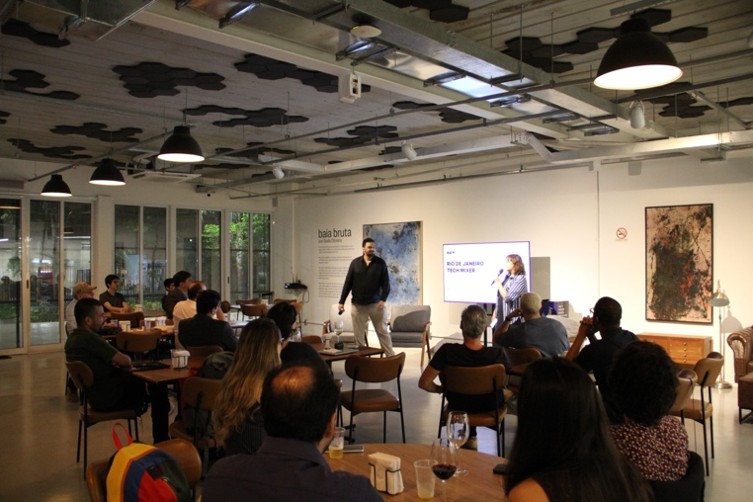
 Our last stop in Brazil took us to the sun and surf of Rio where we hosted two events. The first: a happy hour co-hosted with Maravalley, an innovation hub in downtown Rio where founders of all sizes can access workspace, mentoring support, events, and opportunities for connections and networking with other members of the ecosystem. During our event, Alex and Mitchel once again held a fireside chat about building a business in Europe, this time, sharing insights on how policymakers in Brasilia are looking to regulate tech and where European regulation may be a model.
Our second event in Rio came with a slightly different audience. We hosted a half-day public seminar on SEPs. The seminar brought together state and federal judges, officials from the Administrative Council for Economic Defense (CADE), economists, academics, and practitioners. Through a series of panels, the event allowed for constructive discussion of how Brazil’s institutions can approach SEP licensing in a way that is predictable, fair, and consistent with international practice. The timing was significant, because Brazil is rapidly becoming one of the world’s most active venues for SEP enforcement. Assertions there are also spreading beyond smartphones into video codecs, streaming services, televisions, connected cars, and health products.
 Discussion covered a range of key topics, from injunctive relief and good-faith negotiation to valuation methods, royalty stacking, and the effects of SEP licensing on startups and small businesses. The seminar reinforced ACT’s role as a trusted voice in Brazilian innovation policy and will serve as a springboard for the sustained advocacy that will be critical to advancing a balanced SEP licensing ecosystem in Brazil.
What we learned
“Brazil is not for amateurs.”
That’s a refrain we heard across our stops and throughout our meetings. And it makes sense: Brazil is a unique ecosystem, and each state has a different approach to building and supporting tech and innovation hubs and districts. The country is primed and ready to lead in AI, becoming both a destination for startups to build and grow and a haven for larger companies looking to invest in or acquire startups.
And that connects back to what makes this market unique. In each state, what we saw was a concerted effort to build innovation districts through partnerships. There is seed financing that comes from combining public funds and private funds. Physical spaces that provide desk space for companies, mentorship opportunities and acceleration support, pipelines to talent and to customers. There are a lot of industry-specific opportunities in spaces like oil and gas, agtech, and energy, but there is also support from university consortiums to support creative tech and research-driven tech in medical fields and deep tech.
In our conversations, AI policy and tax reforms came up as major concerns for startups. Questions around what digital markets will look like in Brazil and how closely Brasilía will look to Brussels as a regulatory model routinely surfaced. We heard repeatedly that companies want to engage with policymakers, but they need a playbook and guidance on where to start.
So, what did we learn? That we still have a lot to learn. Brazil is home to a robust and well-established technology ecosystem. Startups, founders, and ecosystem leaders are ready to engage with policymakers to further support what they built, and to ensure the future of tech in Brazil. They are ready to understand cross-border expansion and look to new markets, and they are ready to share their stories about how they built a Brazilian tech ecosystem from the ground up.
We can’t wait to help!
Share this post
Resources
More action
Resources to understand more on the topic
Keep reading
Others on this topic
Get in touch
Contact ACT
Whether you're a technology company looking to grow, or a policymaker seeking insight, we're here to help.
Get in touch to learn more about our work, explore membership, or connect with our team.
United States
United Kingdom
European Union